

travel expert

Speak with Hari Gurung +9779768604351

Short Annapurna Circuit Trek – 8 Days

Trip Facts

Starting/Ending Point

Kathmandu/ Kathmandu

Duration

8 Days

Max. Altitude

5,416 m / 17,769 ft

Accommodation

Teahouses

Activity Per Day

4-6 hours of walking

Best Season

Spring (March to May) and Autumn (September to November)

Group Size

1 - 20

Meals Included

Breakfast, lunch, and Dinner

Difficulty

Challenging

Activity

Trekking in Nepal

Nature Of Trek

Teahouse trekking

Transportation

By Public Transportation

Short Annapurna Circuit Trek Overview

The Annapurna Circuit Trek (ACT) is a bucket-list destination for adventure seekers, especially those with previous trekking experience. But not everyone has two to three weeks to spend on a journey in today’s busy world. But don’t worry. A Short Annapurna Circuit Trek is a shorter version of the standard Annapurna Circuit Trek that lets you experience the Himalayan beauty and challenge of Thorong La Pass within 8 days. Therefore, this trek is ideal for experienced trekkers who want to complete the Annapurna Circuit in a shorter time without missing its major highlights.

Same as the standard route, the Short Annapurna Circuit Trek takes you through traditional mountain villages, river valleys, cliffs, and alpine landscapes. Similarly, there won’t be any compromise on mountain scenery as you’ll get to see the Annapurna and Dhaulagiri ranges on most of your route.

The 8 days Annapurna Circuit Trek route begins with a drive from Kathmandu to Chame. From Chame, your official Annapurna Circuit trekking journey begins. You walk through Upper Pisang, Manang, Ledar, Thorong High Camp, and cross Thorong La Pass (5,416 m) on the seventh day. The same day, you’ll descend to Muktinath, and the final day takes you from Muktinath to Pokhara by ride. And the good part? Even the shorter version lets you adapt to the changing altitude for your safety by including an acclimatization day at Manang.
8 Days Annapurna Circuit Trek Memorable Moments

  • Experiencing the major highlight and challenge, Thorong La Pass, even on a short duration.
  • Exploring Manang Valley, its traditional villages, glacial valleys, and impressive mountain scenery.
  • Admiring amazing sights of Annapurna II, Annapurna III, Gangapurna, Tilicho Peak, Nilgiri, and the Dhaulagiri Range from different sections of the route.
  • Observing the change from pine forests and river valleys to alpine areas and dry landscapes, even in a short duration.
  • Visiting a sacred pilgrimage site, Muktinath, known for its religious significance to both Hindus and Buddhists.
  • Experiencing local mountain lifestyle, traditional architecture, Buddhist monasteries, prayer flags, and warm hospitality along the route.
  • Using road transportation to bypass a long downhill walk without missing key highlights of the trek.

Altitude Progress on 13 Days Langtang Gosainkunda Trek

Day 01: Drive from Kathmandu (1,324 m / 4,343 ft) to Chame (2,670 m / 8,760 ft) via Besisahar (760 m / 2,493 ft)

  • Altitude Gain: 1,910 m / 6,267 ft
  • Altitude Loss: 564 m / 1,850 ft

Day 02: Trek from Chame (2,670 m / 8,760 ft) to Upper Pisang (3,300 m / 10,827 ft)

  • Altitude Gain: 630 m / 2,067 ft
  • Altitude Loss: 0 m / 0 ft

Day 03: Trek from Upper Pisang (3,300 m / 10,827 ft) to Manang (3,540 m / 11,614 ft)

  • Altitude Gain: 240 m / 787 ft
  • Altitude Loss: 0 m / 0 ft

Day 04: Acclimatization day in Manang (3,540 m / 11,614 ft)

  • Altitude Gain: Depends on chosen hike
  • Altitude Loss: Depends on chosen hike

Day 05: Trek from Manang (3,540 m / 11,614 ft) to Ledar (4,200 m / 13,780 ft)

  • Altitude Gain: 660 m / 2,166 ft
  • Altitude Loss: 0 m / 0 ft

Day 06: Trek from Ledar (4,200 m / 13,780 ft) to Thorong High Camp (4,850 m / 15,912 ft)

  • Altitude Gain: 650 m / 2,132 ft
  • Altitude Loss: 0 m / 0 ft

Day 07: Trek from Thorong High Camp (4,850 m / 15,912 ft) to Muktinath (3,760 m / 12,336 ft) via Thorong La Pass (5,416 m / 17,769 ft)

  • Altitude Gain: 566 m / 1,857 ft
  • Altitude Loss: 1,656 m / 5,433 ft

Day 08: Drive from Muktinath (3,760 m / 12,336 ft) to Pokhara (820 m / 2,690 ft) via Jomsom (2,720 m / 8,924 ft)

  • Altitude Gain: 0 m / 0 ft
  • Altitude Loss: 2,940 m / 9,646 ft

Short Annapurna Circuit Trek – 8 Days Itinerary

Day 01 :

Drive from Kathmandu (1,324 m / 4,343 ft) to Chame (2,670 m / 8,760 ft) via Besisahar (760 m / 2,493 ft)

Overnight Stay

Chame

road

Drive Distance

250–270 km / 155–168 miles

Drive Duration

9–11 hours

Highest Altitude

2,670 m / 8,760 ft (Chame)

Meals

Breakfast, Lunch and Dinner

Accommodation

Teahouse

The Short Annapurna Circuit starts with a drive from Kathmandu to Chame via Besisahar, the traditional gateway to the Annapurna Circuit. The road follows the Trishuli and later the Marsyangdi River, with changing scenery along the way. After passing through the hill settlements, you’ll notice a clear transition from city surroundings to Nepal’s countryside. Terraced fields cover the hillsides, small villages appear along the road, and waterfalls and streams become more common during the journey.

As you pass Besisahar, the landscape changes. You follow mountain villages, suspension bridges, waterfalls, cliffs, and forested slopes. Depending on the road condition, some sections can be bumpy and slow. The journey may take longer than the estimated driving time, especially after rainfall or during periods of road maintenance. However, the changing landscape makes this one of the more memorable driving days of the trek.

After several hours on the road, you reach Chame, an administrative headquarters of Manang District. The atmosphere here is cooler than in Kathmandu. After checking into the teahouse, take some time to rest and explore the nearby area. Chame is also known for its natural hot springs, where you can relax after the long drive if conditions and time allow. Overnight stay and dinner at Chame’s teahouse.

Day 02 :

Trek from Chame(2,670 m / 8,760 ft) to Upper Pisang (3,300 m / 10,827 ft)

Trek Distance

13.2 km / 8.2 miles

Trek Duration

5–6 hours

Overnight Stay

Upper Pisang

Highest Altitude

3,300 m / 10,827 ft

Meals

Breakfast, Lunch, and Dinner

Accommodation

Teahouse

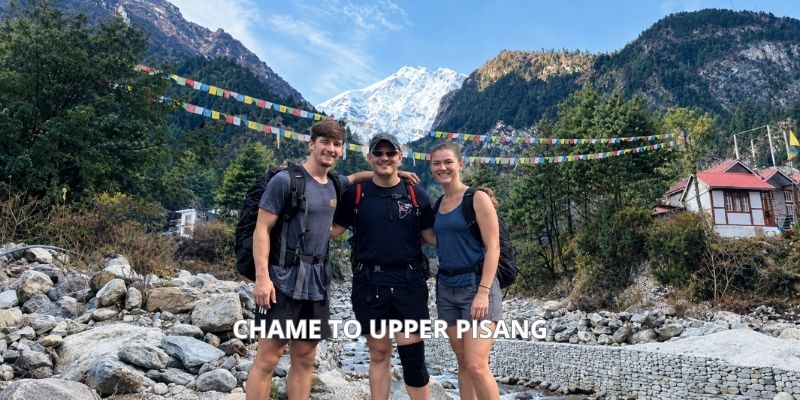
The second day of the Short Annapurna Circuit Trek begins on foot with a walk from Chame to Upper Pisang. The day begins with a hearty morning meal in crisp mountain air. After breakfast, you pack your belongings and make your way towards the day’s destination. The route follows the Marsyangdi River and passes through peaceful forested sections where pine and fir trees provide a refreshing mountain atmosphere.

As the trek continues, the surrounding scenery seems alpine, and the first sight of the impressive peaks of the Annapurna range comes into view. After hours of walking, you reach Telekhu. From there, the pathway continues toward Bhratang, passing through dense forest and sections of the old trekking route. The sound of the Marsyangdi River remains a companion as the route winds through the valley.

Soon after, you reach Bhratang, a beautiful settlement along this section of the Annapurna Circuit. The route also passes through areas associated with apple cultivation. From Bhratang, the landscape becomes more stunning. The trail passes through steep rock formations and forest before reaching the area around Dhukur Pokhari.

Trekker Group In Chame to Upper Pisang Route

Day 03 :

Trek from Upper Pisang (3,300 m / 10,827 ft) to Manang (3,540 m / 11,614 ft)

Trek Distance

15–16 km / 9–10 miles

Trek Duration

6–7 hours

Overnight Stay

Manang

Highest Altitude

Manang (3,540 m / 11,614 ft)

Meals

Breakfast, Lunch, and Dinner

Accommodation

Teahouse

Day 3 is one of the most beautiful sections of the Annapurna Circuit Trek, which takes you from Upper Pisang to Manang through the high-altitude villages of Ghyaru and Ngawal. As usual, the day begins with a warm cup of tea and breakfast at your overnight stay point. As the trek begins, you make your way toward the steepest sections of the day’s route.

Looking back toward Pisang, you can see the Marsyangdi Valley below, surrounded by Himalayan peaks. The climb eventually takes you to Ghyaru, a traditional mountain village with stone houses, barley fields, prayer flags, and Buddhist culture. From Ghyaru, the trek continues through an open section of the upper valley toward Ngawal. Compared with the forested landscape around Chame, the surroundings here are drier.

Ngawal is another traditional village with old stone houses and Buddhist architecture. From Ngawal, the route continues downhill toward Manang. As you get near Manang, the impressive peaks of the Annapurna range are visible throughout the route. After getting to Manang, you check into the teahouse.

After checking into your teahouse, you can explore the village and its narrow stone-paved streets, visit monasteries, and walk around the nearby fields. You can also just rest and enjoy views of the Himalayan peaks. Stay overnight in Manang.

Day 04 :

Acclimatization day in Manang (3,540 m / 11,614 ft)

Trek Distance

Depends on chosen day hike

Trek Duration

Depends on chosen day hike

Overnight Stay

Manang

Highest Altitude

Depends on chosen day hike

Meals

Breakfast, Lunch, and Dinner

Accommodation

Teahouse

By the third day, you will have reached an elevation above 3,500 m. At this altitude, your body needs time to adjust to the lower oxygen levels, making proper acclimatization essential. Acclimatization is essential to let your body adapt to the changed altitude and surroundings. So, the fourth day on the Short Annapurna Circuit is an acclimatization day to prepare you for the upcoming challenge of Thorong La Pass.

The day begins with a relaxed breakfast followed by a short walk around Manang. A morning walk through the village provides an opportunity to explore its traditional stone houses, narrow lanes, prayer wheels, monasteries, and agricultural fields. Later on, you can go for a day hike to nearby viewpoints.

One of the popular acclimatization hikes from Manang is Gangapurna Lake, formed from glacial meltwater below the surrounding mountains. The hike starts from the village and takes you to impressive views of the Gangapurna Glacier and surrounding peaks.

Besides, you can also explore a Himalayan Rescue Association (HRA) Aid Post, located in Manang. The HRA is a non-profit organization established in 1973 to help reduce casualties in the Nepal Himalayas, with a particular focus on preventing and treating altitude-related illnesses.

Wherever you go during the day, you must return to Manang in the evening for dinner and an overnight stay.

Manang Village

Day 05 :

Trek from Manang (3,540 m / 11,614 ft) to Ledar (4,200 m / 13,780 ft)

Trek Distance

9.1 km / 5.6 miles

Trek Duration

4–5 hours

Overnight Stay

Ledar

Highest Altitude

4,200 m / 13,780 ft (Ledar)

Meals

Breakfast, Lunch, and Dinner

Accommodation

Teahouse

After an acclimatization day in Manang, the Short Annapurna Circuit Trek continues toward Ledar. The trek begins after breakfast with a climb out of Manang. The trek follows the upper Marsyangdi Valley before turning toward the Jharsang Khola Valley in the initial phase. The trek then reaches Tenki, a small settlement above Manang, from where the route continues uphill.

Beyond Tenki, the pathway continues through open terrain toward Gunsang. The surrounding landscape becomes drier and more challenging as the route takes you above the tree line. This section offers views of Annapurna III, Gangapurna, and the Chulu peaks. Gunsang is a small mountain settlement where you can take a short break before continuing toward Yak Kharka.

From Gunsang, the trek continues toward Yak Kharka, a high-altitude seasonal settlement whose name refers to the yak pastures found in the area. After Yak Kharka, you’ll continue for another hour toward Ledar. To reach the village, you’ll pass a suspension bridge and sections of uneven mountain trail. Fifth day’s overnight stay and dinner are in Ledar village.

Day 06 :

Trek from Ledar (4,200 m / 13,780 ft) to Thorong High Camp (4,850 m / 15,912 ft)

Trek Distance

7–8 km / 4.3–5 miles

Trek Duration

4–5 hours

Overnight Stay

Thorong High Camp

Highest Altitude

4,850 m / 15,912 ft (Thorong High Camp)

Meals

Breakfast, Lunch and Dinner

Accommodation

Teahouse

The morning begins in Ledar, surrounded by barren hills, rocky slopes, and Himalayan scenery. After breakfast, the trek continues along the upper Jarsang Khola valley. From this section, you’ll experience the landscape changing as trees almost disappear and only alpine vegetation is seen around.

The trail includes sections of loose rock and landslide-prone terrain, so you should walk carefully. After several hours, you reach Thorong Phedi. The word Phedi refers to the bottom or foot of a mountain pass. It is also a rest and lunch point. For trekkers who feel tired or are experiencing altitude-related symptoms, Thorong Phedi also provides a lower overnight option. However, this itinerary continues to High Camp after a suitable rest.

After Thorong Phedi, the most challenging part of the day’s trek starts. You will follow a rocky path with several switchbacks as you climb toward Thorong High Camp. Because the air is very thin at this altitude, the climb can feel harder than expected. Walk slowly, take short breaks when needed, and avoid rushing. Despite the challenging ascent, the impressive mountain views will encourage you along the way.

After the steep climb, you will finally reach Thorong High Camp, where you spend the night before crossing Thorong La Pass the next morning.

Day 07 :

Trek from Thorong High Camp (4,850 m / 15,912 ft) to Muktinath (3,760 m / 12,336 ft) via Thorong La Pass (5,416 m / 17,769 ft)

Trek Distance

14–16 km / 8.7–10 miles

Trek Duration

7–9 hours

Overnight Stay

Muktinath

Highest Altitude

5,416 m (Thorong La)

Meals

Breakfast, Lunch and Dinner

Accommodation

Teahouse

Day 7 is one of the most important and challenging days of the Short Annapurna Circuit Trek. The day starts before sunrise. You’ll leave Thorong High Camp with a headlamp and packed lunch. From High Camp, you’ll climb steadily toward the Thorong La Pass. As you continue, the air starts to thin, so even a short climb can feel tiring. The surrounding landscape is mostly barren, with rocky slopes and high mountain ridges.

After several hours of climbing, you’ll finally reach Thorong La Pass at 5,416 m. Colorful prayer flags flutter in the wind around the pass, and it seems like they’re congratulating you for successfully reaching the highest point of the trek. From the top, you can enjoy views of the surrounding Himalayan landscape on both sides of the pass. From Thorong La Pass, you can see the Dhaulagiri Range, Annapurna II, Annapurna III, Annapurna IV, Gangapurna, Tilicho Peak, and Nilgiri.

As Thorong La Pass lies at high altitude, strong winds and rapidly changing weather can make conditions uncomfortable, so don’t stay there for too long. After enjoying your achievement, you’ll descend to Mustang. The descent from Thorong La is steep in places and can be hard on the knees. As you descend, the decreasing altitude may make breathing easier, although the steep trail can be demanding on your knees.

After several hours of descending, you eventually reach Muktinath. It is one of the most important pilgrimage sites in Nepal and holds deep religious significance for both Hindus and Buddhists. After checking into your teahouse, you can rest and, depending on your arrival time and energy level, explore the surrounding pilgrimage area. Stay overnight and have a hearty dinner at Muktinath.

Muktinath Temple

Day 08 :

Drive from Muktinath (3,760 m / 12,336 ft) to Pokhara (820 m / 2,690 ft) via Jomsom (2,720 m / 8,924 ft)

Overnight Stay

Pokhara

road

Drive Distance

180–200 km / 112–124 miles

Drive Duration

8–10 hours

Highest Altitude

3,760 m (Muktinath)

Meals

Breakfast, Lunch and Dinner

Accommodation

Teahouse

After completing the challenging crossing of Thorong La Pass, the Short Annapurna Circuit continues with a long drive from Muktinath to Pokhara. The drive begins in Muktinath and follows the road toward Jomsom, the administrative center of Mustang District. This part of the journey follows the Kali Gandaki Valley, one of the major valleys of the Annapurna and Mustang region.

Passing through Jomsom, the scenery starts to change. The dry, rocky landscapes of Mustang change into forests, waterfalls, terraced fields, rivers, and green hills. The road passes through major settlements such as Marpha, Tukuche, Kalopani, Ghasa, and Tatopani before continuing toward the lower hills.

Along the way, you can continue enjoying views of the surrounding mountain peaks. The drive also offers beautiful scenery, including waterfalls, forests, rivers, and traditional settlements. After a long day on the road, you reach Pokhara. Once you reach the city, you can check into your hotel and relax. Depending on your arrival time and energy level, you can enjoy a peaceful evening around Phewa Lake. Overnight and dinner at a hotel in Pokhara.

What’s Included on Short Annapurna Circuit Trek

  • Private vehicle pick-up and drop-off service between Kathmandu Airport and your hotel.
  • Accommodation at Pokhara (1 night)
  • Travel from Kathmandu to Besisahar via public bus.
  • Continue from Besisahar to Chame by shared jeep
  • All teahouse accommodation during the trek
  • Standard meals ( 3 time meals throughout the trek)
  • Seasonal fruits after dinner
  • Trek Permits (Annapurna Conservation Area Permit)
  • Experienced English-speaking, government-licensed trekking guide
  • Porter (1 porter for two trekkers), max weight limit is 18 kg (9 kg per trekker)
  • Full coverage of wages, meals, lodging, transport, insurance, and gear for guides and porters
  • Trek map
  • Oxygen saturation check every day
  • Water purification tablets
  • Trek completion certification
  • Trekking briefing before departure
  • First aid medical kit carried by the guide
  • Sleeping bags, down jackets, and a duffel bag (one for every two trekkers)
  • Farewell dinner at the end of the trek
  • All government, local taxes, and official expenses

What’s Excluded on the Short Annapurna Circuit Trek

  • Hotel accommodation and meals in Kathmandu
  • International flight ticket
  • For Private Jeep Contact Us.
  • Nepal tourist visa fees
  • Travel insurance (Mandatory and must include high-altitude emergency and helicopter evacuation coverage)
  • Tips for guides, porters, and staff (for recommended culture.)
  • Personal expenses of all kinds (alcoholic drinks, bottled water, hot showers, charging devices, snacks, desserts, laundry, Wi-Fi, phone calls, etc.)

Select Departure Date for Short Annapurna Circuit Trek – 8 Days

From your arrival to the final steps of your trek, we’re here to make your journey easier. Our local team handles the arrangements, guides you along the way, and keeps your safety and comfort a priority.

Schedule:
Pick start date → — 8 Days
Click any date on calendar

Equipment Checklist for Short Annapurna Circuit Trek – 8 Days

Below is the recommended packing list for this trek. Porters carry main duffle bags up to 15 kg (33 lbs) per person, so please keep personal gear within this limit.

Clothing & Layers

  • Moisture-Wicking Base Layers 2-3 tops and bottoms (merino wool or synthetic, avoid cotton)
  • Trekking Shirts 3-4 breathable, quick-dry short and long-sleeve shirts
  • Fleece Jacket / Mid-Layer Warm breathable fleece pullover or softshell jacket
  • Insulated Down Jacket Warm down jacket with hood, rated to -10°C / -15°C
  • Waterproof & Windproof Shell Jacket Breathable rain jacket with hood (Gore-Tex or equivalent)
  • Trekking Pants 2-3 pairs of lightweight, quick-dry hiking pants
  • Waterproof Rain Pants Breathable waterproof shell pants with side zips
  • Breathable Underwear 4-6 pairs of moisture-wicking athletic underwear

Footwear

  • Waterproof Hiking Boots Well broken-in with good ankle support and grip
  • Trekking Socks 4-5 pairs of merino wool hiking socks
  • Thermal Sleep Socks 1-2 pairs of heavy wool socks for high camps and sleeping
  • Camp Shoes or Sandals Lightweight sneakers or sandals for evening teahouse relaxation (Recommended)
  • Trekking Gaiters Light gaiters to keep snow, mud, and scree out of boots (Optional)

Head & Hand Wear

  • Warm Beanie Fleece or wool hat covering ears for chilly mornings and nights
  • Sun Hat or Cap Wide-brim hat or baseball cap for high UV daytime walking
  • UV Polarized Sunglasses Category 3 or 4 sunglasses with side shields for snow glare
  • Neck Gaiter / Buff 2x buffs for trail dust, cold wind, and throat protection
  • Light Liner Gloves Thin fleece or thermal gloves for walking
  • Heavy Waterproof Gloves Insulated windproof and waterproof outer gloves or mittens

Trekking Gear & Packs

  • Daypack (30 to 40 Liters) With padded hip belt, sternum strap, and waterproof rain cover
  • Expedition Duffel Bag (80-100L) Carried by porters, max 15 kg (33 lbs) (Provided by Outbound Treks)
  • 4-Season Sleeping Bag Rated to -10°C / -15°C (available for rent in Kathmandu or Pokhara)
  • Sleeping Bag Liner Cotton, silk, or fleece liner for extra warmth and cleanliness (Recommended)
  • Adjustable Trekking Poles Collapsible poles to reduce strain on knees during descents (Recommended)
  • LED Headlamp With spare batteries or USB charging cable
  • Dry Bags / Stuff Sacks Lightweight waterproof bags to keep clothes and electronics dry (Recommended)

Hydration & Personal Care

  • Water Bottles (Two 1-Liter Bottles) Wide-mouth Nalgene bottles that can hold boiled water safely
  • Water Purification Purification tablets (Aquatabs / Micropur) or portable filter
  • Quick-Dry Travel Towel Medium lightweight microfiber towel
  • Biodegradable Wet Wipes & Tissues Essential for personal hygiene when showers are not available
  • Sunscreen & UV Lip Balm High-SPF sun protection and moisturizing lip balm
  • Hand Sanitizer Pocket-sized sanitizing bottles for pre-meal cleanliness
  • Basic Toiletries Toothbrush, toothpaste, small biodegradable soap

First Aid & Medication

  • Blister Treatment Kit Moleskin, Compeed blister pads, medical tape, antiseptic wipes
  • Altitude Sickness Medication Diamox (Acetazolamide), please consult your doctor for prescription (Recommended)
  • Pain Relievers Ibuprofen or Paracetamol for headaches and muscle aches
  • Digestive & Anti-Diarrhea Tablets Imodium and Oral Rehydration Salts (electrolytes)
  • Throat Lozenges Soothing lozenges for cold dry mountain air (Recommended)
  • Personal Prescription Medicines Full supply for the trek plus 5 extra contingency days

Documents & Electronics

  • Valid Passport & Paper Copies Minimum 6 months validity plus 2 photocopies
  • Travel Insurance Certificate Must explicitly cover emergency helicopter rescue up to 6,000m
  • Cash in Nepalese Rupees (NPR) For hot showers, device charging, tips, snacks, and lodge Wi-Fi
  • Portable Power Bank (10,000-20,000 mAh) Cold temperatures drain batteries quickly, keep warm at night
  • Universal Plug Adapter & Charging Cables Type C/D plug adapter and device cables
  • Passport Photos (4 Copies) For local SIM card registration and trekking permits

Why Choose Short Annapurna Circuit Instead of Standard Version?

The Short Annapurna Circuit Trek is a good option for those who are looking to experience the best parts of the classic Annapurna Circuit without the long trek. It provides a blend of adventure, cultural attractions, mountain viewpoints, and Himalayan landscape in a short period of time.


Bhulbhule to Jagat During Annapurna Circuit TrekHere are the reasons that make the shorter one better than the standard Annapurna Circuit Trek.

Reduce the time to complete the Trek

The big advantage of the Short Annapurna Circuit Trek is its shorter time. The standard itinerary requires about 12-14 days, but a short one can be accomplished in about 8 days depending on the starting and ending points. It is ideal for trekkers with shorter holidays who want to see the Annapurna region.

Experience the Highlights of the Annapurna Region

Although short in duration, the journey lets you see many of the region’s finest sights. It offers sights of mountain scenes, traditional villages, diverse landscapes, and Thorong La Pass (5,416 m) within 8 days. You can experience much of what makes the Annapurna Circuit special without spending many days.

Save on Overall Trekking Costs

A reduction in trekking days will also help to reduce the journey’s overall cost. This is because the cost of hotel, food, guide and porter, and other daily trek expenses is reduced. Although transportation and route choices affect the final price, the shorter itinerary can be a more budget-friendly option.

Less Physical Strain Over a Long Trekking Period

The shorter route reduces the number of consecutive days of trekking, and that is beneficial for those travelers who cannot do several weeks of trekking in the mountains. However, it is important to remember that shorter does not necessarily mean easier. Some sections may involve long walking hours, steep ascents, and high-altitude challenges, particularly around Thorong La Pass.

Enjoy Diverse Landscapes and Local Culture

Although the trail is short, the region’s incredible geographical and cultural variety is still a part of the Short Annapurna Circuit Trek. Trekkers can experience traditional Gurung and Thakali settlements, Buddhist monasteries, mountain valleys, and walk through landscapes from green hills to dry, high-elevation landscapes.

Suitable for Travelers with Limited Holidays

Some people can’t take two or three weeks off from work or from daily life. The short version is designed to make the Annapurna Circuit more accessible to trekkers who don’t have as much time to visit the mountains. You can take a great Himalayan trip without the need for a lengthy vacation.

Short Vs Long Version of Annapurna Circuit

The Annapurna Circuit is one of the most popular treks in Nepal, and it can be completed in two different durations. The classic route is the long one, which requires 12-14 days. Its starting point is low in the Marsyangdi Valley near Besisahar. The short version offers an alternate adventure by bypassing the lower valley by jeep and lasts for 8 days.

Will you miss anything on the shorter version? No. Both routes take you to the same pass, Thorong La Pass 5,416 m as the highest point. Both go through Manang and reach the holy Temple town of Muktinath as the end point. The only difference is the amount of time spent on the trail.

So, what to choose? The option depends on time, fitness, and how much of the trip you want to experience. Let’s see how they differ from each other.

Factors Short version Long (standard) version
Trekking days About 8 About 12 to 14
Usual start point Drive to Chame or Dharapani Drive to Besisahar, then walk
End point Muktinath, then drive Muktinath, continuing down the Kali Gandaki or to Tatopani and Poon Hill
Highest point Thorong La Pass, 5,416 m Thorong La Pass, 5,416 m
Acclimatization Faster gain More natural altitude gain
Scenery Mostly alpine and high desert From subtropical valleys, pine forest, to alpine high desert
Road exposure Skips most of the jeep road More time near roads in the lower sections
Cost Lower overall Higher, due to more days of lodging, meals, and guide fees
Best for Fit trekkers with limited time First-timers at altitude, slow travelers, culture and landscape lovers

What Experiences Are Missed on the Short Annapurna Circuit Trek?

Although the Annapurna Circuit is short, it does not let you miss out on the big excitement moments, such as Manang and the Thorong La Pass. However, a week-long hike without cutting anything leaves some parts of the hike behind. Most of what you miss is at the start, in the lower valley, and at the end, on the walk down the Kali Gandaki. Here’s what you miss:

Lower Marsyangdi valley

Its longer version begins in the warm lowlands of Besisahar and Bhulbhule. You pass rice terraces, banana trees, and small farms along the way. The shorter version skips most of these sections, allowing you to see the landscape mainly from the jeep rather than experiencing it on foot.

Landscape and culture changing slowly

One of the most specific and best parts of the full circuit is to observe the landscape changes, day by day. From Hindu farming villages, you pass into Gurung villages and then into the Buddhist areas with prayer flags, mani walls, and chortens. On the short trek, you start partway through that change, so it feels less obvious.

The walk down the Kali Gandaki

On the standard Annapurna Circuit Trek, you’ll take a long descent to Kagbeni, Jomsom and Marpha, an area associated with the Kali Gandaki River. But on the short trek, you travel that section by jeep, so you’ll experience its charm less closely.

Hot springs of Tatopani and Poon Hill Viewpoint

Many longer itineraries finish with a soak in the natural hot springs at Tatopani. Some continue up to Ghorepani for a sunrise view from Poon Hill over the Dhaulagiri range and the Annapurna range. But the short trek ends with a ride back to Pokhara, then Kathmandu.

FAQs For Short Annapurna Circuit Trek – 8 Days

Short Annapurna Circuit Trek 8 Days FAQ

USD 830 /pp

Connect with Hari Gurung

Your Trek Starts with a Conversation

Our founder started working as a porter at 17. Today, he leads a local trekking team with nearly 15 years of guiding experience. We know these trails through years of work, and we’d love to help you plan your trek in Nepal.