


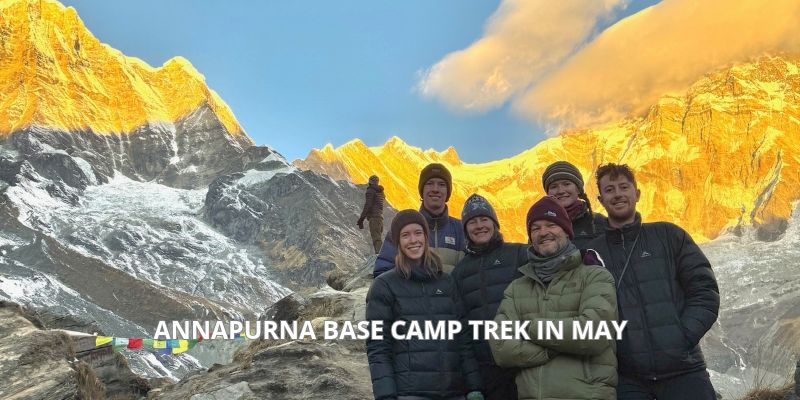
Yes, the Annapurna Base Camp Trek in May is a good choice, especially in the first two weeks of the month. The days are warm, nights at ABC sit just around freezing, and the trail is quieter than in April ABC. Mornings in the Sanctuary are usually clear, but cloud climbs up the Modi Khola gorge by late morning, and from mid-May, afternoon showers and the odd hailstorm become normal.
This guide is written by our team in Pokhara, who walk this route every spring. We will show you how May weather works in the gorge, how early and late May differ, what each day of the trek is like in May, and how to handle the snow, the leeches and the crowds. If you are ready to plan, have a look at our 11-day Annapurna Base Camp Trek.
ABC in May Quick Facts
| What to expect | |
|---|---|
| Best part of the month | 1 to 15 May |
| Day at ABC (4,130 m) | Around 6 to 12°C in the sun |
| Night at ABC | Around -4 to 1°C |
| Day in the lower villages | 20 to 28°C, warm and humid |
| Clear view window in the Sanctuary | Roughly 5 am to 10 am |
| Afternoons | Cloud most days, showers and soft hail more likely after mid-May |
| Rhododendrons | Finished low down, late bloom higher in the forest |
| Snow on the trail | Old patches possible near MBC and ABC, especially early May |
| Crowds | Busy early in the month, quieter by the last week |
| Monsoon arrival in Nepal | Around 13 June on average |
| Our 11-day trek | USD 800, permit, guide, porter and meals included |
Is May a Good Month for the Annapurna Base Camp Trek?
Is the Annapurna Base Camp Trek in May worth it? Yes, but it is not as good as the October Annapurna Base Camp Trek.
In October, the sky after the monsoon is washed clean, and you can see the peaks from sunrise to sunset. May is warmer and softer. The air holds more moisture and dust, and the clouds build earlier in the day. So you trade some of October’s all-day clarity for something else.
In May, you’ll find Warmer nights, for a start. ABC in May usually hovers around freezing at night, while October nights drop well below it. If you are someone who lies awake shivering in an unheated room, that alone changes the trip.
You also get a calmer trail. April is the busiest spring month on the ABC route. By May, especially the second half, many lodges have spare rooms again, and the dining rooms are less packed in the evening.
And you get long days. Sunrise comes early, and you have daylight until around 7 pm, so you never rush to reach the next lodge before dark.
| What You Care About | April | May | October |
|---|---|---|---|
| Morning views | Very good | Good, best early in the month | Best of the year |
| Afternoon views | Hazy | Often cloudy by noon | Usually clear |
| Rhododendrons | Peak bloom | Late bloom, higher up | None |
| Night at ABC | Below freezing | Around freezing | Well below freezing |
| Rain | Low | Rising through the month | Very low |
| Crowds | Heaviest in spring | Moderate, then quiet | Heaviest of the year |
How May Weather Affects ABC & Modi Khola Gorge
The ABC trail does not walk along an open ridge. It climbs up a deep, narrow gorge cut by the Modi Khola river, and then opens into the Sanctuary, a bowl surrounded by peaks. That shape changes how the weather behaves.
In May, on the Annapurna Base Camp Trail, the sun heats the lower valleys around Chhomrong and Jhinu every morning. Warm, damp air rises. The gorge acts like a chimney and funnels it north, straight up towards the Sanctuary. As that air climbs and cools, it turns into cloud.
At dawn, the Sanctuary is clear and the gorge below is full of low cloud. Between 9 and 11 am, that cloud starts creeping up the valley. By early afternoon, it reaches MBC and ABC and hides the peaks. On some evenings, it sinks back down and the summits reappear for sunset. On others, it stays and drizzles.
Once you know this, you can plan your Annapurna Base Camp Trek in May around it. You walk early. You aim to arrive at MBC or ABC by late morning. And you treat any clear evening as a bonus, not a promise.
Temperatures From Pokhara to ABC
| Place | Altitude | May Daytime | May Night |
|---|---|---|---|
| Pokhara | 820 m | 27 to 31°C | 18 to 21°C |
| Ghorepani | 2,860 m | 15 to 20°C | 5 to 9°C |
| Chhomrong | 2,170 m | 20 to 25°C | 11 to 15°C |
| Deurali | 3,230 m | 12 to 17°C | 3 to 7°C |
| MBC | 3,700 m | 8 to 14°C | -1 to 4°C |
| ABC | 4,130 m | 6 to 12°C | -4 to 1°C |
| Jhinu Danda | 1,780 m | 24 to 28°C | 15 to 18°C |
These are typical ranges, not a forecast. A cold front can make ABC feel like winter for a night, even in May. Guides who have walked this route for years have seen snow at ABC in May. Rare, but possible.
Rain, Hail and the Odd Late Snow
Early May is mostly dry on the trail, with a passing shower now and then. From mid-May, showers come most afternoons, especially in the lower forest around Chhomrong, Sinuwa and Bamboo. Higher up, that same weather can fall as soft hail or wet snow.
The real monsoon, with rain all day and swollen rivers, usually reaches Nepal around 13 June. So even in late May, you are mostly dealing with wet afternoons, not wet weeks. And a wet afternoon in a teahouse at Deurali, with a plate of dal bhat and a pack of cards, is honestly not a bad way to spend it.
Snow and Avalanche Risk in May ABC Trek
You may have read about avalanches on the ABC trail. But do avalanches come at the Annapurna Base Camp Trek in May? Generally No.
The risky stretch is the narrow part of the gorge between Hinku Cave, Deurali and MBC, where steep slopes above the trail can release snow. The danger is highest in winter and early spring, after heavy snowfall. By May, most of the winter snow on those slopes has already come down or melted, so the risk is usually much lower than in February or March. It is not zero, though, especially in early May or after a late storm.
In spring, guides sometimes use a variation of the trail on the far side of the river to keep away from old slide paths, if the lodge owners say it is the safer line. They also cross the exposed section early, before the sun softens the snow above, and keep moving without stopping.
Higher up, between MBC and ABC, you may still walk across old snow patches in early May. They can be icy at dawn and slushy by noon. Your guide will tell you if microspikes are worth packing for your dates.
This is exactly where a licensed guide earns their pay. They talk to lodge owners, hear from trekkers coming down, and know when to wait a day at Deurali. Our trekker Casimir from Chicago wrote that his guide adjusted the day six push to Deurali “the moment he noticed a couple of us flagging”. That is the kind of judgement you want on this part of the route.
Rhododendrons, Waterfalls and Wildlife in May
Coming in May does not mean missing the flowers. You just have to look more on the trail.
By May, the big red rhododendron show around Ulleri and the lower forest has mostly finished. Higher up, around Ghorepani, the ridge to Tadapani, and the upper gorge towards Deurali, you can still walk under late pink and white blooms in the first two weeks of the month.
May has other gifts too. The waterfalls across from Dovan and Himalaya roar with snowmelt. The bamboo forest is thick and green. Grey langur monkeys crash through the trees around Bamboo and Sinuwa, and the birdsong in the early morning is loud enough to wake you before your alarm.
Crowds, Teahouses and Booking in May AC
The first two weeks of May are still a busy time on the ABC route, with plenty of trekkers who could not get April dates. By the last week, it quiets down a lot.
The bottleneck is always the top. There are only a handful of lodges at MBC and ABC, so on busy nights the best rooms go early, and late arrivals sometimes share a dorm or sleep in the dining room. This is another reason to walk early in May.
It also helps to have a guide with good relationships. Desmond from Denver wrote that his guide “knew every teahouse owner between Ghorepani and ABC”, which meant “the good rooms” and local stories nobody else heard. In a busy week, that is worth a lot.
One more date to know. In 2027, Buddha Jayanti, the Buddha’s birthday, falls on Thursday, 20 May. It is a national holiday, and Pokhara’s stupas fill with butter lamps. If your trek ends around then, keep an evening free in Pokhara.
Leeches, Humidity and the Lower Trail
Leeches are a monsoon thing, but they start appearing in the lower forest after the first proper rains, usually in the last two weeks of May. The damp sections between Tadapani and Chhomrong, and around Bamboo, are where you are most likely to meet them.
They are harmless, just unpleasant. Tuck your trousers into your socks, check your ankles at rest stops, and carry a small bag of salt. A pinch makes them let go straight away.
The lower trail also gets humid in late May. You will sweat on the stairs around Chhomrong even when the air at ABC is freezing. Quick-dry clothes make a big difference.
What to Pack for ABC in May
Things to wear and carry:
- Two or three quick-dry T-shirts for the warm, sticky lower days.
- A fleece and a warm hat for evenings above Deurali.
- A proper waterproof jacket with a hood for afternoon showers and hail.
- Light gloves for the cold sunrise at ABC.
- Broken-in boots with good grip for wet stone steps.
- Trekking poles for the 1,800 m drop on day 8.
- A headlamp for the early starts at Poon Hill and ABC.
- Sunglasses and strong sunscreen, since the sun bounces off snow in the Sanctuary.
- Long socks and a small bag of salt for leeches in late May.
- A pack cover and dry bags to keep your sleeping clothes dry.
You don’t need to buy a heavy down jacket or a winter sleeping bag. Both are included in our package, along with water purification tablets so you can refill at teahouses instead of buying plastic bottles.
Cost and What Is Included
Our Annapurna Base Camp Trek in May costs the same as any other month: USD 800 per person for 11 days.
That covers your ACAP permit (NPR 3,000), a licensed English-speaking guide, one porter for every two trekkers, 8 nights in teahouses, 2 nights in a Pokhara hotel with breakfast, meals on the trek, transport as listed in the itinerary, a daily oxygen check, and the sleeping bag and down jacket.
What you pay yourself: travel insurance with helicopter rescue cover, hot showers, Wi-Fi and charging, snacks and drinks, and tips. You no longer need a TIMS card for the Annapurna region. Since April 2023, you do need a licensed guide, and ours is included.
One small thing that matters in May. As our Annapurna region guide explains, we use private transport to skip the dusty jeep road sections and drop you where the real footpaths begin. On a hot May morning, that saves you a sweaty hour walking behind trucks.
If You Can Only Go in Late May ABC Trek
Late May still works for ABC, as long as you accept more cloud and some rain. But if you are flexible about where you go, you have options.
The Mardi Himal Trek in May is a shorter trip close to ABC, with similar views of Machhapuchhre and its own week-by-week weather guide.
And if you are coming in late May or June and want to stay dry, look at the Upper Mustang Trek. It sits behind the Annapurna range in a rain shadow, so it stays much drier when the rest of the region gets wet.
What Trekkers Ask About ABC in May
Is May a good time for the Annapurna Base Camp trek?
Will it rain on the ABC trek in May?
Is there snow at Annapurna Base Camp in May?
Is the ABC trek risky in May?
Can beginners do the ABC trek in May?