


To reach Mardi Himal from Pokhara, we will start at Kande, about 27 km from Pokhara on the Baglung Highway. You’ll be in a shared jeep or local bus from Baglung Bus Park (about 1 to 1.5 hours) or a taxi from Lakeside (about 1 hour). Phedi and Dhampus are the other two starting points. At the end, you walk down to Siding and take a jeep back to Pokhara, which takes 2 to 3 hours on a rough road.
The trail itself is well marked once you are on it. Getting to it, and getting back from the other end, is where most travellers lose an hour, overpay, or end up at the wrong village.
This guide shows you how to reach Mardi Himal from Pokhara without that stress. Below, our team explains the three ways in and the one way out, what each one costs, and how to make sure a jeep is there at Siding on the last day.
Where the Mardi Himal Trail Starts
There is no single starting point of the Mardi Himal trek. There are three common starting points on the road, and they all join up at Pothana, where your permit gets checked, before the trail climbs to Pritam Deurali.
| Starting Point | Road From Pokhara | First Walk | Best For |
|---|---|---|---|
| Kande (1,770 m) | About 27 km, 1 to 1.5 hr | Kande to Australian Camp, then on to Pothana | Most trekkers, gentler start |
| Phedi (1,130 m) | About 20 km, 45 min to 1 hr | Long stone staircase straight up to Dhampus | Strong legs, tight budget |
| Dhampus (1,650 m) | About 25 km, about 2 hr by jeep | Short walk to Pothana and Pritam Deurali | Groups with a private vehicle |
| Siding (1,750 m) | Rough jeep road, 2 to 3 hr | Steep climb up to Low Camp | Usually the exit, not the start |
Kande Trekking Start Point
Kande sits right on the Baglung Highway, so any bus or jeep heading that way can drop you there. That is why it is the most popular starting point to mardi himal trek.
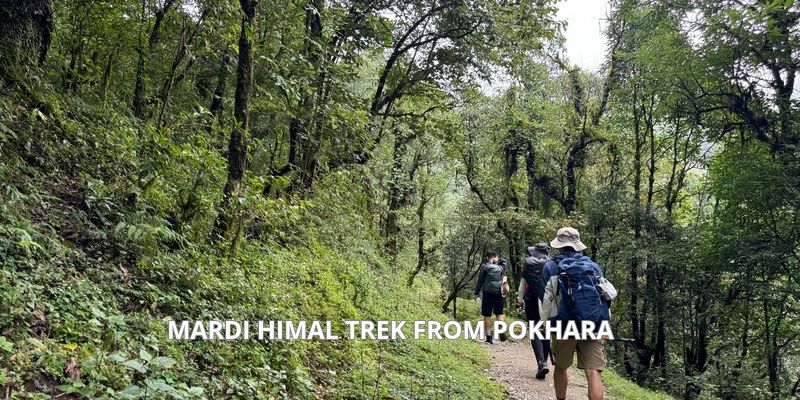
The walk from Kande climbs through forest for about an hour to Australian Camp, a grassy shelf with tea houses and, on a clear morning, a long line of snow peaks to the north. From there it is a fairly easy walk on to Pothana and Pritam Deurali. It is a kind first day, and that matters when your legs have just come off a plane or a long bus ride.
Phedi, Affordable but Many Staircases
Phedi is the closest trailhead to Pokhara, and local buses to it are cheap and frequent. From the road, you walk straight up a long stone staircase towards Dhampus. If you are fit and want to save a few hundred rupees, Phedi works. If it is your first trek, or you are starting late in a hot month, we would pick Kande every time.
Dhampus Start Point
There is a road up to Dhampus, a Gurung village of slate-roofed houses at 1,650 m. On our trek, we drive from Pokhara to Dhampus in about 2 hours, covering roughly 25 km, then walk about 5 km in 3 hours to Pritam Deurali.
When you start from Dhampus, you’ll skip the hot, steep options at the bottom and start walking where you can see the views. On a clear day, Machhapuchhre and Annapurna South show up on your right before you have even left the jeep.
Can You Start From Siding Instead?
You can, but we rarely suggest it. Siding is where most people come out at the end, and walking it in reverse means a steep climb of about 1,200 m up to Low Camp on day one, with only a handful of tea houses on the way.
It also cuts out Forest Camp and the slow, gentle gain in height that helps your body adjust. Unless you have done the trek before, keep Siding for the way down.
Transportation Options from Pokhara to Trail
Once you pick your starting point, you pick your ride. There are four ways to reach Mardi Himal from Pokhara, and each has its own trade-off between time, comfort and hassle.
| Option | Where From | Time | Good If You |
|---|---|---|---|
| Local bus | Baglung Bus Park | 1 to 1.5 hr | Want the cheapest way and don’t mind crowds. |
| Shared jeep | Baglung Bus Park | About 1 hr | Want a quicker ride at a fair price, but finding it is hard. |
| Taxi or private jeep | Lakeside, door-to-door | About 1 hr to Kande | Are a small group, or arrive late |
| Guided trek package | Your hotel in Pokhara | About 2 hr to Dhampus | Don’t want to think about any of it |
For two or three people, a taxi from Lakeside is often worth it. For a solo traveller on a budget, the shared jeep is the sweet spot.
Getting to Kande Step by Step Guide
If you plan to reach Mardi Himal from Pokhara on your own, here is exactly how the morning goes. Read it once and you will walk into the bus park like you have done it before.
Get to Baglung Bus Park Early
Baglung Bus Park is in the north of Pokhara, roughly a 15 to 20 minute taxi ride from Lakeside. Aim to be there by 7:30 am. Shared jeeps leave when they are full, and the early ones fill fastest, especially in October and April.
Have breakfast before you go, or grab tea and a roti at one of the stalls. You won’t find a proper meal until Australian Camp.
Ask the Right Question
The bus park is noisy and a bit chaotic, but people are friendly. Walk up to any driver or conductor and ask, “Kande jaane gaadi kahaa chha?” It means “Where is the vehicle going to Kande?”
Calling the driver “dai”, which means older brother, goes a long way too. Agree on the fare before you get in, and keep small notes ready.
Ride Out
The road heads north-west along the Baglung Highway, past Hemja and its Tibetan settlement, then starts to wind uphill above the Seti valley. Ask the driver to tell you when you reach Kande. It is a small roadside cluster of shops, and it is easy to miss if you are dozing.
Kande, Where Trail Begins
At Kande, look for the stone steps leading up behind the shops, with a sign for Australian Camp. If you are not sure, ask anyone. Everyone in Kande knows exactly why a foreigner with a backpack just got off the bus.
From here, it is about an hour to Australian Camp and roughly another 3 hours to Pritam Deurali. You will show your ACAP permit at the checkpoint in Pothana on the way.
How Far Is Mardi Himal From Pokhara?
| What You Mean | Distance From Pokhara | How Long |
|---|---|---|
| The trailhead at Kande | About 27 km by road | 1 to 1.5 hr by bus, jeep or taxi |
| Pritam Deurali, first night stop | Road plus about 5 to 8 km on foot | Most of the first day |
| High Camp (3,580 m) | Road plus 2.5 to 3 days on foot | Day 3 or 4 of the trek |
| The Viewpoint (4,200 m) | Road plus 3 to 4 days on foot | Usually the sunrise of day 4 or 5 |
| The whole loop on foot | About 41 to 45 km of walking | 4 to 6 days with the drives |
Getting Back to Pokhara From Siding
The walk down from Low Camp to Siding drops about 1,200 m through forest and farmland and takes 3 to 4 hours. You arrive tired, often hungry, in a small Gurung village at the end of a rough jeep road. And then you need a jeep.
Book Your Jeep the Night Before
Tell your tea house owner at Low Camp that you need a jeep from Siding the next day. Most of them know the drivers personally and can call ahead. That way, a vehicle is waiting when you walk in, instead of you sitting on a wall for two hours hoping one turns up.
Shared jeeps run mostly in the morning, so if you are walking down without a booking, start early. A shared seat costs roughly NPR 800 to 1,200. A whole jeep costs several times more, so agree the price before you leave Low Camp.
Drive / Trek from Sidding to Pokhara
The road follows the Mardi Khola down through Lwang and other villages, then joins the paved highway near Hemja for the last stretch into Pokhara. It takes 2 to 3 hours. If the Siding jeeps are not running, you can walk on down the valley to Lumre, where the road is better and vehicles are more frequent.
Another option is to come down from the Forest Camp side towards Landruk and Ghandruk, which links with the Annapurna Base Camp Trek trail and has its own jeep connections to Pokhara. That adds a day or two, but some people love it.
Kathmandu to Mardi Himal Trek
Most people reach Pokhara first day and start the trek the next morning. That is what we recommend too.
You have two ways to get from Kathmandu to Pokhara. A tourist bus takes 6 to 8 hours on the Prithvi Highway, and the drive along the Trishuli River is a nice look at the countryside. A flight takes about 25 minutes and lands at Pokhara International Airport, but it costs a lot more and can be delayed by weather.
Can you fly in and start walking the same day? It is possible if you land early, but we don’t suggest it. One night in Pokhara gives you time to sort your permit, buy last-minute snacks, check the weather, and sleep properly before the climb. If you are getting your own ACAP permit, you can buy it at the Nepal Tourism Board office in Pokhara.
Things That Go Wrong on the Road, and How to Avoid Them
Most of the time, the drive to reach Mardi Himal from Pokhara goes smoothly. But a few things trip people up again and again, so here they are.
Festival days change everything. During Dashain and Tihar in October and November, buses are packed with families heading home, and some drivers raise their prices. Book a private vehicle in advance if your dates fall on a festival.
Monsoon rain closes roads. From June to September, landslides sometimes block the Mardi Khola road to Siding for a day or two. In those months, have a backup plan for the way down, like walking on to Lumre.
Late starts cost you. If you reach Kande at noon in April or May, you will climb the hottest part of the trail in the hottest part of the day. Leave Pokhara by 8 am if you can.
How Transfers Work on Our 6-Day Trek
On our 6-day Mardi Himal Trek, you don’t have to think about any of this. Here is how the transport works.
On Day 1, you drive from Kathmandu to Pokhara, about 200 km in 6 to 7 hours. On Day 2, after breakfast, you drive about 25 km to Dhampus in roughly 2 hours and start walking from there. On Day 6, you walk down from Low Camp to Siding, and a jeep takes you back to Pokhara along the Mardi Khola, about 60 km in 2 to 3 hours.
Your licensed guide handles the bookings, the bargaining and the timing, and carries your ACAP permit through the checkpoints. All of that is included in the USD 380 price, along with your meals, tea house rooms and a porter for every two trekkers.
Questions About Getting to Mardi Himal
Can you reach Mardi Himal from Pokhara by car?
Is there a direct bus from Pokhara to Mardi Himal?
How much does a taxi from Pokhara to Kande cost?
Can you do Mardi Himal without a guide?
What is the easiest way to reach Mardi Himal from Pokhara?