


Yes, the Mardi Himal Trek in May is worth doing, especially in the first two weeks. You get clear, warm mornings, milder nights at High Camp than in April, late rhododendrons above 2,800 m and fewer people on the trail. The catch is the afternoons. From mid-May, cloud and the odd thunderstorm roll in after lunch, so every good view happens at sunrise.
It is 3:40 in the morning at High Camp. Someone knocks on your door with a flask of hot ginger tea. You pull on your gloves, step outside, and do the one thing every May trekker does first.
If you see stars, you smile. Machhapuchhre is out there in the dark, and in an hour and a half it will turn pink right in front of you. If you see nothing but grey, your guide just shrugs and says, “Let’s walk. It often opens up at the top.”
That little moment sums up a Mardi Himal Trek in May. It is a month of good odds, not guarantees. And whether you come home with the view of your life or a phone full of cloud mostly depends on when you go and how you plan your days.
We wrote this guide so you can plan it right. It comes from the people who walk this ridge with our groups every spring, so you will find the stuff the brochures leave out: which week to book, why the moon matters, and what to do when thunder starts at 3,500 m.
If you already know May is your month, talk to our team about May 2027 dates. Or set up a private trek on the days that suit you.
May Mardi Himal Trek Facts
| What to expect | |
|---|---|
| Best dates | 1 to 14 May |
| Daytime in the forest camps | 12 to 24°C |
| Night at High Camp (3,580 m) | about 0 to 5°C |
| Sunrise at the Viewpoint | around 5:15 am |
| Your clear view window | roughly 5 am to 9 am |
| Afternoons | Cloud most days, showers and thunder after mid-May |
| Rhododendrons | Finished lower down, still out from about 2,800 to 3,500 m |
| Crowds | Steady in early May, quiet by the last week |
| Monsoon arrival in Nepal | Around 13 June on average |
| Our 6-day package | USD 380, permit and licensed guide included |
Is May a Good Time to Go?
Yes In May, the mountains show up early and leave early. If you are standing at the Viewpoint by sunrise, your chances are good, especially in the first half of the month. If you are still having breakfast at 9 am, you might miss them entirely.
That is the big difference from October, when the sky can stay clear until sunset. And it is the reason some agencies quietly avoid May. But here is the thing nobody mentions. May fixes two problems that April and October both have.
The first is the cold. Nights at High Camp in May sit around 0 to 5°C. In April they dip below freezing, and in October colder still. If you are someone who lies awake shivering in a cold room, that alone can make your trip.
The second is the crowd. April is the busiest spring month on this trail, and October is the busiest of the whole year. By May, the rush has passed. You get a seat by the stove, a room without booking a week ahead, and long stretches of forest with nobody in front of you.
| What You Care About | Mardi in April | May | October |
|---|---|---|---|
| Morning mountain views | Very good | Good, best early in the month | Best of the year |
| Afternoon views | Hazy | Often gone by noon | Mostly clear |
| Rhododendrons | Peak bloom, 2,200 to 3,000 m | Late bloom, higher up only | None |
| Night at High Camp | -2 to 4°C | 0 to 5°C | -5 to 2°C |
| Rain and storms | Low | Rising through the month | Very low |
| Crowds | Heavy | Moderate, then quiet | Heaviest |
So who should pick May? Trekkers who feel the cold, who want space on the trail, and who don’t mind an alarm at 3:30 am. Who should not? Anyone who needs clear views all day long, or who will be crushed by one cloudy morning. For them, October is the safer bet.
Early May and Late May Mardi Himal Trek
Typical conditions from past May seasons. Five filled dots means the most of that thing.
If there is one thing to take from this guide, it is this. Book your Mardi Himal Trek in May for the first half of the month if you possibly can.
Why such a big difference in just a few weeks? Because May is when the wet air from the Bay of Bengal starts pushing north towards the Himalaya. It does not arrive all at once. It creeps in, a little more each week, and the ridge feels every step of it.
First Week in Mardi Trek May
Early May is honestly a really good time to be up here. Mornings are sharp and blue. The first puffs of cloud don’t show up until mid-morning, and on many days they stay small.
The flowers have finished in the lower forest, but between Low Camp and Badal Danda you still walk under red and pink rhododendrons. And because the April crowds have gone home, you often get the dining room at Forest Camp almost to yourself.
Second Week in Mardi Trek May
Not much changes in week two, except the air. A thin haze builds by late morning, so your photos after 9 am come out a bit washed and flat. Afternoons are mostly dry, with the odd short shower.
It is still a very good week to go. You just have to be stricter about your morning start.
Third Week in Mardi Trek May
Around the middle of the month, the pattern shifts. Clouds climb out of the valleys by 10 or 11 am, and a shower or a rumble of thunder after lunch becomes normal. Mornings, though, are still usually clear enough for the sunrise you came for.
This is also the week of Buddha Jayanti, which falls on Thursday, 20 May in 2027. More on why that matters for your trek in a moment.
Last Week Mardi Himal May Trek
Late May is the wild one. Storms build most afternoons, sometimes with hail on the ridge. The lower forest turns hot and sticky, and after the first proper rain, leeches wake up below Forest Camp.
Does that mean you should skip it? Not always. The trail is at its emptiest, the forest is deep green, and plenty of dawns are still clear. You just need to go in with your eyes open, and with a guide who knows when to turn around.
How Warm Is It During the Mardi Himal Trek in May?
The weather on a Mardi Himal Trek in May depends far more on your altitude than on the date. In four days you go from 820 m in Pokhara to 4,200 m at the Viewpoint, so you basically walk from early summer into late winter.
| Place | Altitude | May Day | May Night | How It Feels |
|---|---|---|---|---|
| Pokhara | 820 m | 27 to 31°C | 18 to 21°C | Hot, humid, fan weather |
| Pritam Deurali | 2,100 m | 18 to 24°C | 10 to 14°C | Mild, a light fleece at night |
| Forest Camp | 2,550 m | 15 to 21°C | 7 to 11°C | Cool and shady under the trees |
| Low Camp | 2,970 m | 12 to 18°C | 4 to 8°C | Fresh, jacket after sunset |
| High Camp | 3,580 m | 8 to 14°C | 0 to 5°C | Cold night, sleep in your layers |
| Viewpoint at dawn | 4,200 m | -3 to 3°C | Not a sleeping stop | Windy, fingers go numb fast |
On Day 2 you will sweat through your T-shirt on the stone steps above Dhampus. On Day 5 you will scrape frost off the grass with your boot. That is a swing of more than 30°C, and it shapes everything you pack.
Does it rain on the Mardi Trail in May?
There are rarely rainy days in May on the Mardi Himal Trail. Early May is mostly dry on the trail. From mid-May, rain usually comes in the afternoon, often after you have already reached your teahouse.
The real monsoon, with its all-day rain and mud, normally reaches Nepal around 13 June. So even in late May, you are dealing with a wet afternoon, not a wet week. And a wet afternoon in a warm teahouse, with a plate of momos and a pack of cards, is not the worst thing in the world.
Morning Hike for Sunrise View at Mardi View Point
This is the day the whole trek is built around. On a Mardi Himal Trek in May, it is also the day when timing matters most.
You wake at 3:30 am. Tea, a biscuit, maybe a boiled egg if your stomach agrees. At 4:00 you leave High Camp with headlamps on, walking in a slow line up the dark grassy ridge. The air is still and cold. Nobody talks much.
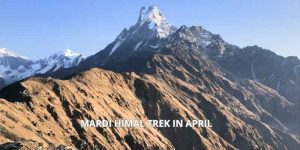
After about 2 to 2.5 hours, you reach the Viewpoint at 4,200 m, usually just as the sky starts to glow. Sunrise comes around 5:15 am in May. First the very top of Machhapuchhre catches the light, then Annapurna South, then Hiunchuli, and for about twenty minutes everyone forgets how cold their hands are.
From here, your guide makes a call. Continue to Base Camp, or head back down?
Mardi Viewpoint or Base Camp in May?
May is actually a better month than April for reaching Base Camp at 4,500 m. Most of the old winter snow on that last narrow ridge has melted by now. In May, the limit is the clock and the sky, not the snow.
Base Camp takes another 1.5 to 2 hours from the Viewpoint. That means you only go if the group is strong and the sky is clear early.
| What Your Guide Sees at Sunrise | What Usually Happens |
|---|---|
| Clear sky, strong group, at the Viewpoint before 6 am | On to Base Camp, turn back by about 8 am |
| Clear sky, but the group is slow or tired | Enjoy the Viewpoint, then head down |
| Cloud already building at sunrise | Wait at the Viewpoint for a gap, then go down early |
| Fresh snow or hail from the night before | Stop at the Viewpoint, the ridge is too slippery |
By 8 am, everyone is heading down. You are back at High Camp for lunch by about 11, and walking down through Badal Danda to Low Camp in the afternoon. And yes, you might get wet on that last bit. But you will have your sunrise in the bag.
Insider tip: Many trekkers think the Viewpoint is the better photo spot anyway. From Base Camp you stand right under Machhapuchhre, but the side ridges block part of the wider range.
The Moon, the Stars and the Buddha’s Birthday
Here is something almost nobody plans for, and it can change your whole trip. Check the moon before you book.
Around the new moon, which falls in the first week of May in 2027 (about 6 May), the nights are properly dark. From High Camp, far above the valley lights, you can see the core of the Milky Way rising before dawn over the peaks. If you love the night sky, this is your window, and it also lines up with the clearest weather of the month.
Two weeks later comes the full moon of Baisakh, which is Buddha Jayanti, the Buddha’s birthday. In 2027 that is Thursday, 20 May. On a clear night, the moon lights up the snow so brightly that you barely need your headlamp on the climb to the Viewpoint. Walking up a silver ridge towards a moonlit Machhapuchhre is something you will not forget.
Down in Pokhara, the stupas fill with butter lamps and families on Buddha Jayanti, including the World Peace Pagoda above Phewa Lake. In the Gurung villages around the trail, this full moon also opens the season of the Ghatu dance. If you hear drums from a courtyard as you walk past, stop for a minute. Most people never get to see it.
Where the Flowers Went, and Where to Find Them
Worried you will miss the rhododendrons? You won’t. You just have to climb a little higher to find them.
The bloom on Mardi Himal moves up the hill like a slow wave. In April it peaks between 2,200 and 3,000 m. By May, the lower trees have dropped their petals, so the forest around Pritam Deurali is green and full instead of red. Then, somewhere above Low Camp, you walk into colour again. Between about 2,800 and 3,500 m, late red, pink and white flowers hang on into the first weeks of May.
The forest has other things going on too. Orchids cling to the mossy trunks around Forest Camp. Primulas open in the grass near High Camp. Grey langur monkeys crash through the oak trees lower down, and if you are lucky, you will spot a Danphe, the Himalayan monal and Nepal’s national bird, near the shrubs below High Camp. Its feathers look like someone spilled petrol in the sunlight.
And in some villages, May is honey season, since the harvest follows the bloom. Ask at your teahouse in Siding on the last day. A spoon of fresh spring honey in your tea is a pretty good way to end a trek.
Storms, Slippery Roots and Leeches
Let us talk about the three things that worry people planning a Mardi Himal Trek in May. None of them should stop you. But knowing how we handle them should make you feel a lot calmer.
What Happens if Thunder Starts on the Ridge?
Above Low Camp, the trail runs along an open grassy ridge with no trees to hide under. In the second half of May, afternoon storms can build fast, sometimes with hail.
This is exactly why our May plan is built around mornings. You walk the exposed bits early and reach your teahouse by early afternoon on most days. If thunder starts while you are still out, your guide moves the group down off the crest and away from high points, and you wait it out. Storms up here are usually short. Half an hour later, the sun can be out again.
The Steps and Roots Get Slippery
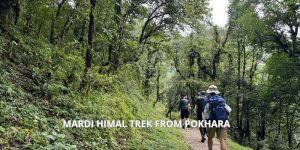
Afternoon rain turns the stone steps near Dhampus and the root-covered path below Forest Camp slick. The long descent from Low Camp to Siding on the last day is where most people feel it in their knees. Poles help a lot. So do boots with real grip, not running shoes.
Leeches in the Lower Forest
After the first proper rains in late May, leeches start showing up in the forest below Forest Camp. They look horrible and they are completely harmless. Tuck your trousers into your socks, check your ankles at rest stops, and carry a small bag of salt. One pinch and they let go. Your guide will show you the trick on the first day.
Mardi Himal Trek Cost in May
A Mardi Himal Trek in May costs the same as any other month with us: USD 380 per person for 6 days.
| Included in the USD 380 | You Pay Yourself |
|---|---|
| ACAP permit (NPR 3,000) | Travel insurance with helicopter rescue |
| Licensed English-speaking guide | Hot showers, about USD 3 to 5 |
| One porter for every two trekkers, 9 kg each | Phone charging and Wi-Fi |
| Teahouse rooms for 5 nights | Snacks, bottled drinks and desserts |
| Breakfast, lunch and dinner on the trek | Tips for your guide and porter |
| Transport as listed in the itinerary | Nepal visa and flights |
| Sleeping bag, down jacket and duffel bag | Personal gear like poles and rain gear |
| Daily oxygen check and first aid kit |
Packing for Mardi Himal Trek in May
| Bring This | Why It Matters in May |
|---|---|
| 2 or 3 quick-dry T-shirts | The lower days are hot and sweaty, and cotton never dries |
| A proper rain jacket with a hood | Afternoon showers are likely after mid-May |
| A thermal base layer | High Camp is the one cold night, and teahouse rooms are not heated |
| Warm hat and light gloves | The Viewpoint at dawn feels below freezing with the wind |
| Headlamp and spare batteries | The summit walk starts at 4 am in the dark |
| Trekking poles | The 1,200 m descent to Siding is hard on the knees, more so when wet |
| Pack cover and dry bags | Keeps your sleeping clothes dry if the afternoon turns wet |
| Long socks and a small bag of salt | Your defence against late-May leeches |
| Sunglasses and strong sunscreen | The sun above 3,500 m burns fast, even through cloud |
Questions Trekkers Ask About Mardi Himal in May
Is May too late in the season for Mardi Himal?
Will it rain every day in May?
Can I still see rhododendrons in May?
Can beginners do the Mardi Himal Trek in May?
Mardi Himal or Poon Hill in May?
If you want to get close to big mountains, choose Mardi Himal. If you want a lower, gentler trek with less exposure to afternoon storms, the Ghorepani Poon Hill Trek is the easier pick. For something quieter still, look at the Khopra Danda Trek, or compare them all on our Annapurna region treks page.