

The Namche Bazaar to Tengboche section of the Everest Base Camp trek is one of the most memorable and iconic sections, typically on day 4 of the itinerary. The day takes you from the busy streets of Namche Bazaar to the calming Tengboche village. It also marks a transition from the busy atmosphere of Namche to the quieter surroundings of Tengboche. The day’s trek takes you alongside the Dudh Koshi River with views of Mount Everest, Ama Dablam, Lhotse, Nuptse, Thamserku, and Kangtega. The day also showcases the beauty of the Khumbu Valley in a different light.
The distance from Namche Bazaar to Tengboche is 9.2 km and takes 5-6 hours. The route first passes through Kyangjuma and Sanasa, where you can enjoy Himalayan views before descending to Phunki Tenga. After Phunki Tenga, the walk becomes challenging as it climbs constantly through forested slopes towards Tengboche. Overall, the day’s trek is moderately challenging with a combination of uphill and downhill sections. However, the previous day’s acclimatization at Namche Bazaar makes this day quite manageable.
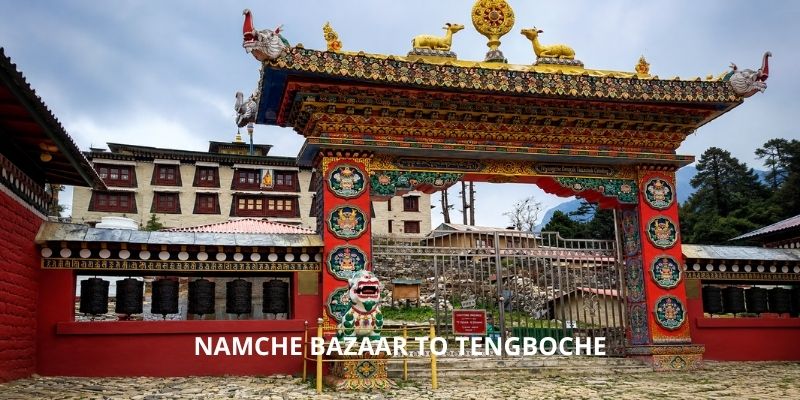
The highlight of the day is reaching Tengboche Monastery, the most significant Buddhist monastery in the Khumbu region. Surrounded by prayer flags, prayer wheels, mani stones, and chortens, the monastery’s scenery is peaceful and a great place to rest and reflect after a long day of trekking.
Namche Bazaar to Tengboche At a Glance:
- Starting Point: Namche Bazaar (3,440 m)
- Ending Point: Tengboche (3,855 m)
- Net Elevation Gain: 415 m
- Highest Point on Route: Tengboche at 3,855 m
- Distance Covered: 9.2 km
- Walking Time: 5-6 hours
- Trek Difficulty: Moderate
- Challenging Section: Phunki Tenga to Tengboche climb
- Oxygen Availability: About 67% at Namche Bazaar and about 64% at Tengboche
- Major Highlights: Mount Ama Dablam, Dudh Koshi River, rhododendron forests, and Tengboche Monastery
- Overnight Stop: Tengboche
Namche Bazaar to Tengboche Distance
The distance from Namche Bazaar to Tengboche is 9.2 km (5.71 miles) and takes 5-6 hours. It is a moderately difficult, beginner-friendly EBC route. However, trekking time depends on your pace. Although the distance sounds short, the trek is not easy as it involves constant elevation changes. The trek does not simply climb from Namche to Tengboche. Instead, it follows a steady path towards Kyangjuma and Sanasa in the initial phase. Then it descends to Phunki Tenga and climbs steeply again through pine and rhododendron forests to Tengboche.
Namche Bazaar to Tengboche Segment-by-Segment Distance:
| Route Segment | Approx.Distance | Approx.Walking Time | Trail Character |
| Namche Bazaar → Kyangjuma | 2.5 km | 1-1.5 hours | Gradual uphill and relatively easy |
| Kyangjuma → Sanasa | 1.2 km | 25-40 minutes | Mostly gradual with mountain views |
| Sanasa → Phunki Tenga | 2.5 km | 1-1.25 hours | Descending through forest toward the Dudh Koshi |
| Phunki Tenga → Tengboche | 3 km | 2-2.5 hours | Steep uphill climb |
| Overall | 9.2 km | 5-6 hours | Moderate |
3 Location Highlights of Namche Bazaar to Tengboche Trek Route
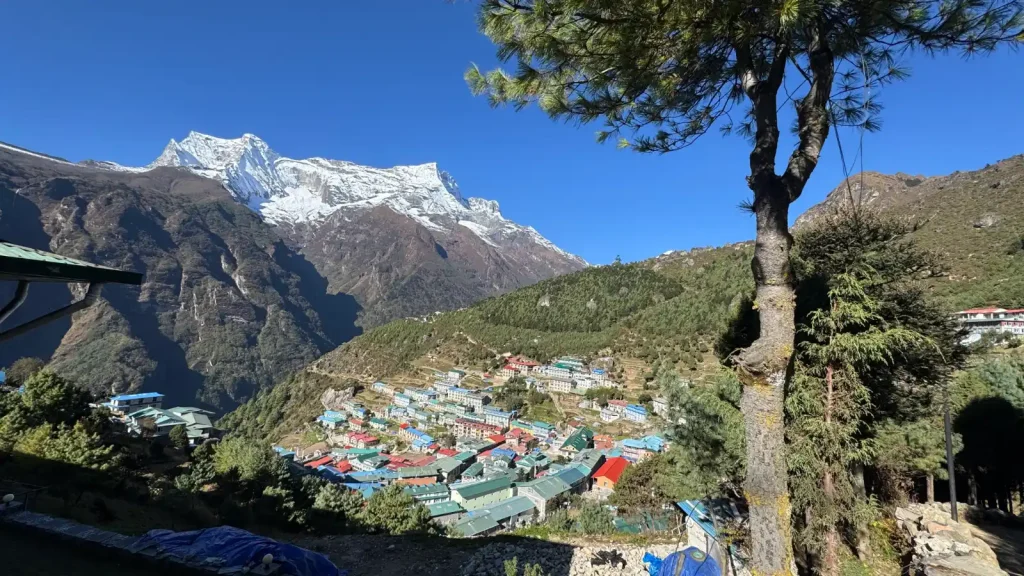
Namche Bazaar to Tengboche is one of the most visually stunning sections of the Everest Base Camp Trek, with numerous natural and cultural attractions. It is also a section where the raw beauty of the Himalayas combines with Sherpa culture, ancient monasteries, and peaceful mountain landscapes. As you leave Namche Bazaar, the trek takes you through forests of pine and rhododendrons and slowly changes its form into an open landscape. Along the way, you can enjoy the sight of mountain peaks while experiencing the unique attractions of the Khumbu region.
Here are three major location highlights of the Namche Bazaar to Tengboche trek route that make your adventure worth every effort and this section memorable:
Tengboche Monastery
Located at an elevation of 3,855 meters, Tengboche Monastery is not only an attraction but also a spiritual highlight of the Khumbu Valley. Established in 1916, it is one of the most important and famous Buddhist monasteries in the Khumbu region. The monastery sits on a hilltop, with Himalayan peaks including Ama Dablam surrounding this cultural landmark. This setting creates a peaceful, calming place for exploration and meditation.
Similarly, the area surrounding the Tengboche Monastery offers exceptional views of the Dudh Koshi Valley, rhododendron forests, and fluttering prayer flags in the crisp mountain air. Mani Rimdu is an annual Buddhist festival held at Tengboche, with dates varying according to the Tibetan lunar calendar. The broader ritual cycle lasts 19 days, while the main public celebrations take place over three days. It is a celebration with sacred masked dances and community rituals. Beyond the festival, trekkers may be able to enter the monastery when it is open and observe its traditional Buddhist interior and religious atmosphere.
Phunki Tenga
Phunki Tenga is a riverside village located at an elevation of 3,250 meters that offers a refreshing stop on the Namche Bazaar to Tengboche trek. Lying beside the Dudh Koshi River, the area is known for its flowing river, dense forests, and traditional prayer wheels. If you trek here in spring, you’ll see blooming rhododendrons in different colors. Phunki Tenga is also a lunch stop on the way to Tengboche from Namche Bazaar, so you get enough time to enjoy the area’s beauty while having food.
Scenic View of Ama Dablam, Lhotse, Nuptse, and Everest
One of the major highlights of the Namche to Tengboche route is the impressive mountain views. This section offers clear views of Ama Dablam, Lhotse, Nuptse, Thamserku, Kangtega, and even Everest. These mountain views are not only stunning, but also help motivate you to keep going. Among all the peaks, Ama Dablam will be your constant companion with its pyramid-shaped form, and it becomes even more amazing as you get closer to Tengboche.

Namche Bazaar to Tengboche Difficulty
The Namche Bazaar to Tengboche trek is moderately difficult, and the reason is not influenced by distance. At 9.2 km, this is one of the shorter days on the Everest Base Camp trail.
This is because the trail makes you climb the same height twice over. You gain, then lose 340 m at the river, then climb 605 m to finish. That final push alone is bigger than the day’s entire net gain, and it starts after you have already been walking three hours.
| Factor | Difficulty | Why |
|---|---|---|
| Distance | Easy | 9.2 km is short by EBC standards |
| Elevation Profile | Challenging | 605 m of climbing packed into the last 3 km |
| Altitude | Moderate | Thin air turns a one-hour climb into a two-hour one |
| Descent Impact | Moderate | The steep drop to the river is what your knees will remember |
However, you come into this day with two nights at Namche Bazaar behind you, and that matters more than any other factor. Trekkers who skip the acclimatization day find this climb genuinely hard. Trekkers who take it usually find it fair.
Four things make the day easier:
- Start by 7 am: You get the climb done before the afternoon cloud builds.
- Eat at Phunki Tenga: The lunch stop sits at the bottom of the hardest climb. Do not push past it.
- Use poles on the descent: The drop to the river does more damage than the climb does.
- Slow down before you feel tired: Short standing breaks beat long sitting ones on the final ascent.
Are There Any Permit Checkpoints During Namche Bazaar to Tengboche Route?
Yes, there are permit checkpoints along the Namche Bazaar to Tengboche route. The permit checkpoint is located right at the edge of Namche Bazaar as you leave the village and head toward Tengboche. At the checkpoint, oficials/checkpoint staff may check trekkers’ documents before they continue towards Tengboche, Dingboche, and Everest Base Camp. Here, they check the Sagarmatha National Park entry permit and the Khumbu Pasang Lhamu Rural Municipality permit.
Besides the checkpoint near Namche, there is one main checkpoint at Monjo/Jorsale. It is the official entrance point for Sagarmatha National Park, where your permits are checked. Nepal Tourism Board specifically identifies the Jorsale checkpoint, lying just above Monjo, as the point where permits for trekking in the region should be checked. Therefore, the Namche checkpoint serves as an additional document-verification and route-control point for trekkers continuing into the region, rather than a major checkpoint.
Namche Bazaar to Tengboche Route Breakdown
The Namche Bazaar to Tengboche route can be categorized into four parts, and the difficulty is not spread evenly across them. The first three routes are easy. The fourth is a bit difficult compared to the previous.
- Stage 1, Namche Bazaar to Kyangjuma (3,550 m): A contour path along the hillside. Easy walking, and the views arrive early.
- Stage 2, Kyangjuma to Sanasa (3,594 m): Short and level. Sanasa is where the trail forks, with the left path heading to the Gokyo Lakes and the right path continuing to Tengboche. You are standing at the junction of two of Nepal’s biggest trekking routes.
- Stage 3, Sanasa to Phunki Tenga (3,250 m): You give back 340 m of height here. This is the lowest point on the trail anywhere north of Namche Bazaar.
- Stage 4, Phunki Tenga to Tengboche (3,855 m): You climb 605 m in 3 km. There are almost no flat stretches to recover on. The painted kani archway at the top tells you the day is over.
FAQs About Namche Bazaar To Tengboche
How long does it take to trek from Namche Bazaar to Tengboche?
What is the highest point on the Namche to Tengboche trail?
Are there teahouses along the way for breaks during the Namche to Tengboche route?
What mountain views can I expect on the Namche Bazaar to Tengboche section?
Is the Namche to Tengboche trail suitable for beginners?