


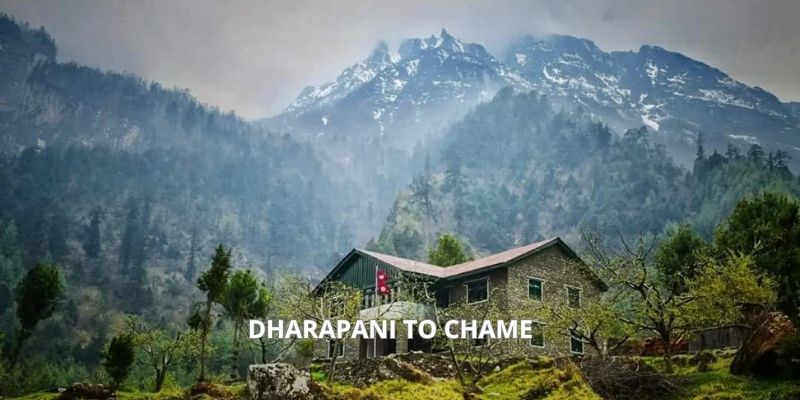
The trek from Dharapani to Chame covers about 15.5 km and takes around 6 hours. You climb from 1,860 m to 2,670 m, a gain of 810 m. Most of that climb comes in the morning, on stone stairs between Danaqyu and Timang. After lunch, the trail gets much easier.
The walk from Dharapani to Chame is the biggest uphill day on our itinerary before the pass. You gain 810 m in a single day. That is more than Manang to Ledar, and more than Ledar to High Camp.
It just means you need to walk it the right way. Start early, take the stairs slowly, and eat a proper lunch in Timang. This trail is also where the Annapurna Circuit Trek changes its face. You leave the warm, green lower valley behind. You walk into pine forest, see your first Tibetan-style villages, and sleep above 2,500 m for the first time.
In this guide, our guides share the real distance, the elevation profile, the route village by village, and what Chame is like when you arrive. If you are still planning, you can talk to our team on WhatsApp and get your 14-day Annapurna Circuit itinerary sorted today.
Dharapani to Chame Distance and Walking Time
On our 14-day Annapurna Circuit, the walk from Dharapani to Chame measures 15.5 km. Our guides plan for about 6 hours of walking, plus a lunch break. So you will usually leave Dharapani around 7 am and reach Chame by mid-afternoon.
Faster walkers sometimes finish in 4.5 to 5 hours. Slower groups, or groups who stop for lots of photos, can take 7 hours or a little more. Both are completely fine. This is not a race, and honestly, the people who rush this day often pay for it in the evening.
How the Day Compares to the Days Around ACT Trek
| Day | Route | Distance | Walking Time | Altitude Gain |
|---|---|---|---|---|
| Day 3 | Jagat to Dharapani | 15 km | 5 to 6 hrs | 560 m |
| Day 4 | Dharapani to Chame | 15.5 km | 6 hrs | 810 m |
| Day 5 | Chame to Upper Pisang | 13.2 km | 5 to 6 hrs | 630 m |
| Day 8 | Manang to Ledar | 9.1 km | 4 to 5 hrs | 660 m |
| Day 9 | Ledar to Thorong High Camp | 7.3 km | 4 to 5 hrs | 650 m |
How Hard Is the Hike From Dharapani to Chame?
This is a moderate to demanding day. Between Danaqyu and Timang. You walk up stone steps for close to two hours, with only short flat bits in between. After Timang, the day changes. The trail rolls gently through pine forest, dips a little to Koto, then climbs softly into Chame. Many trekkers tell us the afternoon feels like a reward for the morning.
First Night Above 2,500 Metres
Chame sits at 2,670 m. For most of our trekkers, this is the highest they have ever slept. And you may notice small changes.
Uphill steps feel heavier by afternoon. Your appetite may drop a little at dinner. Sleep can be lighter than usual. These are normal reactions at this height, not warning signs.
Who Finds This Day Hardest
In our experience, it is not always the least fit people. Often it is the strong walkers who race up the Timang stairs in the first hour. They arrive in Chame with a headache and no appetite.
Steady trekkers who keep a talking pace usually feel fine. So if you can hold a conversation while climbing, you are going at the right speed. Your guide will set that pace from the first step.
Dharapani to Chame Elevation Profile
The table below shows how the hike goes through the day. Altitudes are rounded, and times assume a steady pace with short breaks.
| Village | Altitude | Approx. Time From Dharapani | Change From Previous Stop |
|---|---|---|---|
| Dharapani | 1,860 m | Start | None |
| Bagarchhap | 2,160 m | 1 hr | About +300 m |
| Danaqyu | 2,300 m | 1.5 to 2 hrs | About +140 m |
| Timang | 2,750 m | 3 to 3.5 hrs | About +450 m |
| Thanchowk | 2,630 m | 4.5 hrs | About -120 m |
| Koto | 2,600 m | 5 to 5.5 hrs | About -30 m |
| Chame | 2,670 m | 6 hrs | About +70 m |
Timang is actually higher than Chame. You hike to about 2,750 m before lunch, then lose a bit of height in the afternoon.
Day 4 Village by Village Trail Info
This is the exact route our guides take from Dharapani to Chame with every group.
Dharapani to Bagarchhap and Danaqyu
You leave Dharapani after breakfast, usually tea, toast or a plate of Tibetan bread with honey. The air is cool, and the Marsyangdi River roars below the trail. Your guide shows your ACAP permit at the checkpoint here, so you just wait a few minutes.
About an hour later, you reach Bagarchhap. Look at the houses. The roofs are flat, the walls are stone, and prayer flags flap on long poles. This is the first village on the circuit where Tibetan Buddhist culture really shows.
Danaqyu comes next, a long village stretched along the trail. Fill your water bottle here. The next part needs it.
Danaqyu to Timang: Stone Stairs & Forest
Just past Danaqyu, the trail turns left and starts climbing. And it keeps climbing. Stone steps zigzag up through pine, fir and rhododendron forest for close to two hours.
After rain, the steps get slippery and muddy. Trekking poles help a lot here, both for your knees and your balance. In spring, the rhododendrons flower red and pink right over your head, and you forget about your legs for a minute.
Then the forest opens, and you walk into Timang. Cows with big brass bells graze in green meadows. On a clear morning, Manaslu rises to the east, its snow catching the sun. Where else on the circuit do you get an 8,000 m peak with your lunch?
We usually stop in Timang to eat. A plate of dal bhat here does more for your afternoon than any energy bar. Sit in the sun, refill your tea, and let your legs rest.
Timang to Thanchowk and Koto: Pine Forest & Nar Phu Turn Detour
After lunch, the hard work is mostly done. The trail rolls through tall pine forest, with needles soft under your boots. You will cross the jeep road a few times, then slip back into the trees.
Some groups take the slightly longer path through Thanchowk, a quiet village on a ridge with apple trees and old stone houses. It adds a little time but far fewer jeeps. Your guide decides based on the weather and how your group feels.
Koto comes next. There is a second permit check here, and also a trail junction heading north. That path leads into the Nar Phu Valley, a restricted area with its own special permit. If you ever want a quieter, wilder trek, our 9-day Nar Phu Valley Trek starts right from this point.
Koto to Chame
From Koto, Chame is only about 2 km away. The walk takes around 25 to 30 minutes on an almost flat trail. You cross the river, pass a row of prayer wheels, and walk into the village.
Look up as you arrive. Annapurna II and Lamjung Himal sit right above the valley. After six hours on the trail, a hot tea with that view feels earned.
Jeep Road or Walking Trail on Day 4
The jeep road now runs the full length of this valley. So should you walk the road, the trail, or skip the day by jeep?
Here is how our guides think about it.
| Option | Good For | Downside |
|---|---|---|
| Forest trails with short road sections | Most trekkers. Better views, quiet paths, proper acclimatization | Steeper stairs, muddy after rain |
| Walking mostly on the jeep road | Wet days when forest steps are too slippery | Dust, passing jeeps, less shade |
| Shared jeep to Chame | Trekkers very short on time | You miss the acclimatization benefit of walking up slowly |
Our standard plan is to walk. The day helps your body adjust to height before Pisang and Manang, and skipping it pushes more altitude into fewer days. Between you and me, that is a trade we rarely recommend.
Staying in Chame, Headquarters of Manang District
Chame is not just another overnight stop. It is the headquarters of Manang District, so it has more facilities than any village since Besisahar. That makes it a good place to rest well and stock up before the trail gets higher and drier.
Teahouses and Rooms in Chame
Chame has the widest choice of lodges on this side of the circuit. Rooms are twin-share, with simple beds, thick blankets and pillows. Many lodges have attached bathrooms, and some have gas-heated showers that actually stay hot.
Hot showers usually cost around USD 3 to 5. Wi-Fi and phone charging also cost a little extra. Our package covers your room and all three meals, so you only pay for these small extras.
Most trekkers on the circuit sleep in Chame. So the trail out of the village gets busy right after breakfast. Our guides prefer lodges near the far end of the village, which lets your group get ahead of the morning crowd.
Shops, Health Post and Cash
You can buy snacks, batteries, toilet paper, chocolate and basic medicine in Chame. There is also a health post and a police post. If you forgot something in Kathmandu, this is a good place to fix it.
Cash is the one thing to plan carefully. Chame has an ATM, but it does not always work with every card, and the withdrawal limit is low with a high fee. So please bring enough Nepali rupees from Kathmandu or Pokhara, and treat the ATM as backup only.
What to Do in Chame After You Arrive
You will usually have a free afternoon. Here are a few easy ways to spend it without tiring your legs:
- Visit the small village gompa, with its prayer wheels and old wall paintings.
- Walk to the hot spring near the river and soak your feet for a while.
- Climb a short hill behind the village for a clear look at Annapurna II.
- Stroll the riverside and watch the glacier-blue Marsyangdi rush past.
Permits and Checkpoints on This Trail
You need one permit for this part of the trek. That is the Annapurna Conservation Area Permit, or ACAP. It costs NPR 3,000 for foreign trekkers and NPR 1,000 for SAARC nationals.
You no longer need a TIMS card for the Annapurna region. Many older blogs still mention it, so do not get confused. Foreign trekkers must, however, trek with a licensed guide in Nepal now.
On the trail from Dharapani to Chame, you pass two checkpoints, one at Dharapani and one at Koto. Our package already includes your ACAP, and your guide carries it and handles every check. You just stand by, sip some water and enjoy the view.
Season Overview
| Season | Daytime in Chame | Night in Chame | Trail Feel |
|---|---|---|---|
| Spring (Mar to May) | 10 to 18°C | -2 to 5°C | Flowers, mild, some afternoon cloud |
| Autumn (Sep to Nov) | 10 to 17°C | -2 to 5°C | Clear, dry, busy |
| Winter (Dec to Feb) | -2 to 8°C | Down to -10°C or lower | Cold, very quiet |
| Monsoon (Jun to Aug) | 15 to 22°C | 8 to 12°C | Wet, muddy, cloudy |
Advice From Our Guides for the Walk to Chame
Our lead guide grew up in the mountains and started as a porter at 17. He has spent more than 12 years guiding on Nepal’s trails, and he has walked this valley more times than he can count. Here is what he tells every group before Day 4.
Start by 7 am. The stairs above Danaqyu are much easier in the cool morning than in the midday sun. Starting early also gives you a relaxed lunch in Timang.
Go slower than you want to on the stairs. Count steps if it helps. A slow, steady pace gets you to Timang feeling fine, while a fast pace leaves you flat for the rest of the day.
Eat a real lunch, even if you don’t feel hungry. Appetite drops with altitude, but your body still needs the fuel. Dal bhat, noodle soup or a big plate of fried rice all work.
Tell your guide early if you get a headache. It is usually nothing serious at this height. But catching it early always makes the next days easier.
One of our trekkers, Cody from Phoenix, put it well after his trip. He said the rest and pacing on the way up are what gave him the legs for Thorong La. That pacing starts right here, on Day 4.
Chame to Upper Pisang: What Day 5 Looks Like
The next morning, you leave Chame and head to Upper Pisang at 3,300 m. The walk covers 13.2 km in 5 to 6 hours, with 630 m of climbing.
You pass the apple orchards of Bhratang, where you can try a fresh apple pie. Then the valley swings around the huge curved rock face of Paungda Danda. The forest thins, the air gets drier, and the land starts to look more and more Tibetan.
If Dharapani to Chame is the bridge, Day 5 is where you step onto the other side. By evening, you are looking straight across at Annapurna II from Upper Pisang.