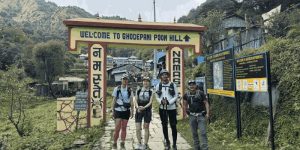



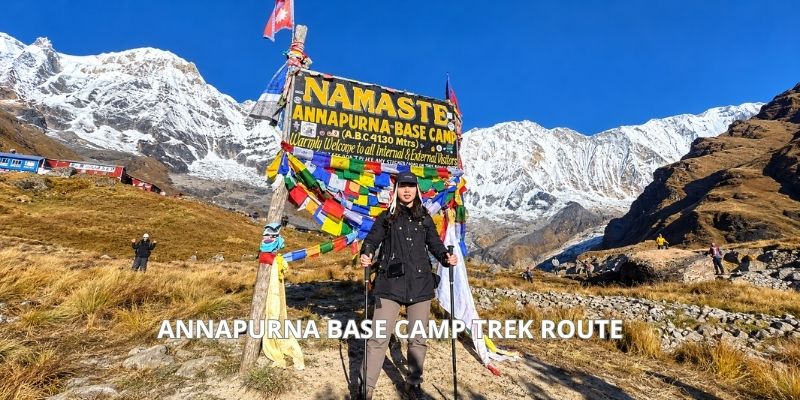
Each path for Annapurna Base Camp trek ultimately merges into the upper track. You begin at the end of a road close to Pokhara, including Tikhedhunga for Poon Hill, Kimche for Ghandruk, or Siwai and Jhinu Danda for the shortest path. All converge at Chhomrong. From there, one path leads through Sinuwa, Bamboo, Dovan, Himalaya, Deurali, and Machhapuchhre Base Camp to Annapurna Base Camp at an elevation of 4,130m. The whole distance is around 70 to 110 km and takes 5 to 12 days.
| Fact | Detail |
|---|---|
| Gateway city | Pokhara (820m) |
| Common road heads | Tikhedhunga, Kimche, Siwai or Ghandruk Phedi, Jhinu Danda, Kande |
| Where routes meet | Chhomrong (2,170m) |
| Highest point | Annapurna Base Camp (4,130m / 13,550ft) |
| Round-trip distance | About 70 to 80 km direct, about 110 km with Poon Hill |
| Trekking days | 5 to 9 on the trail, plus travel days |
| Daily walking | 4 to 7 hours |
| Permits | ACAP permit plus a TIMS card |
| Best months | March to May, late September to November |
Imagine yourself standing in Pokhara, and you have got five different Annapurna Base Camp trek routes. The ABC trek is funnel-shaped. There are several options to enter the lower part of the mountains, but after Chhomrong, there is only one way to go to the base camp.
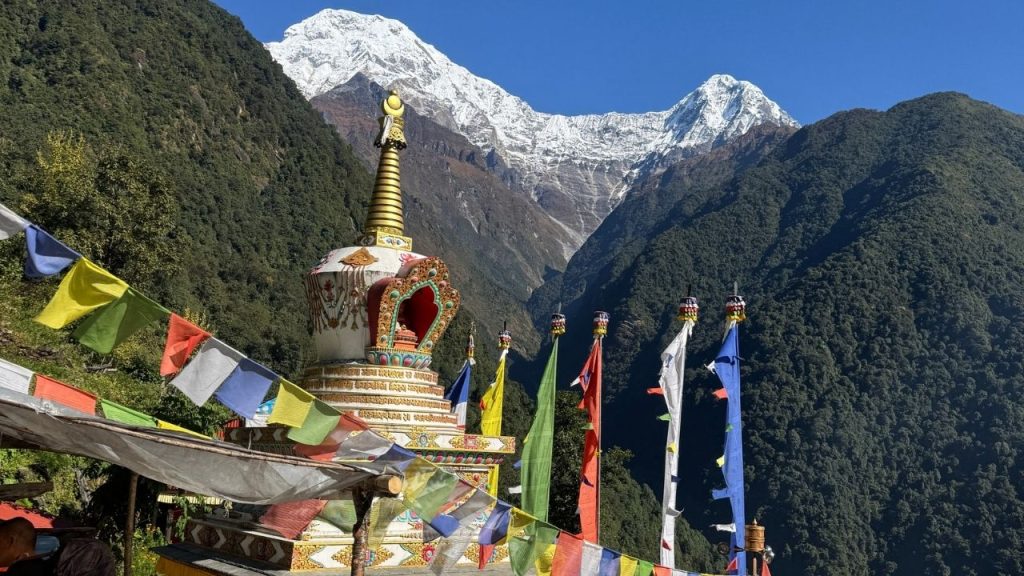
Therefore, choosing a particular route is choosing a starting point. Are you more interested in the sunrise at Poon Hill, a night in a large Gurung village, or the shortest route to the Sanctuary? Below, we describe in detail each option, the upper part of the trekking route step by step, its distances, and changes in 2026.
Choosing Your ABC Trek Starting Point
Here is how the four common ways in compare. Days are counted from the road head to Chhomrong.
| Approach | Road head | Days to Chhomrong | What you get | Best for |
|---|---|---|---|---|
| Poon Hill | Tikhedhunga, past Nayapul | 3 to 4 | Poon Hill sunrise, rhododendron forest, Ulleri’s 3,200+ stone steps | First-timers with 10 or more days |
| Ghandruk | Kimche | 2 | Big Gurung village, Annapurna South views, gentler first days | Most trekkers with about a week |
| Jhinu | Siwai, Ghandruk Phedi or Jhinu Danda | Half a day | Fastest way in, hot springs close by | Fit trekkers short on time |
| Landruk | Kande, via Australian Camp | 2 | Quieter east-bank trail, Fishtail views | Trekkers pairing ABC with Australian Camp |
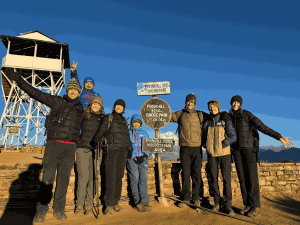
Which one? If you have 10 days and beyond, choose Poon Hill. You get to see the most beautiful sunrises around, not forgetting that the additional days spent at altitudes ranging from 2000 meters to 3000 meters give your body enough time to acclimatize.
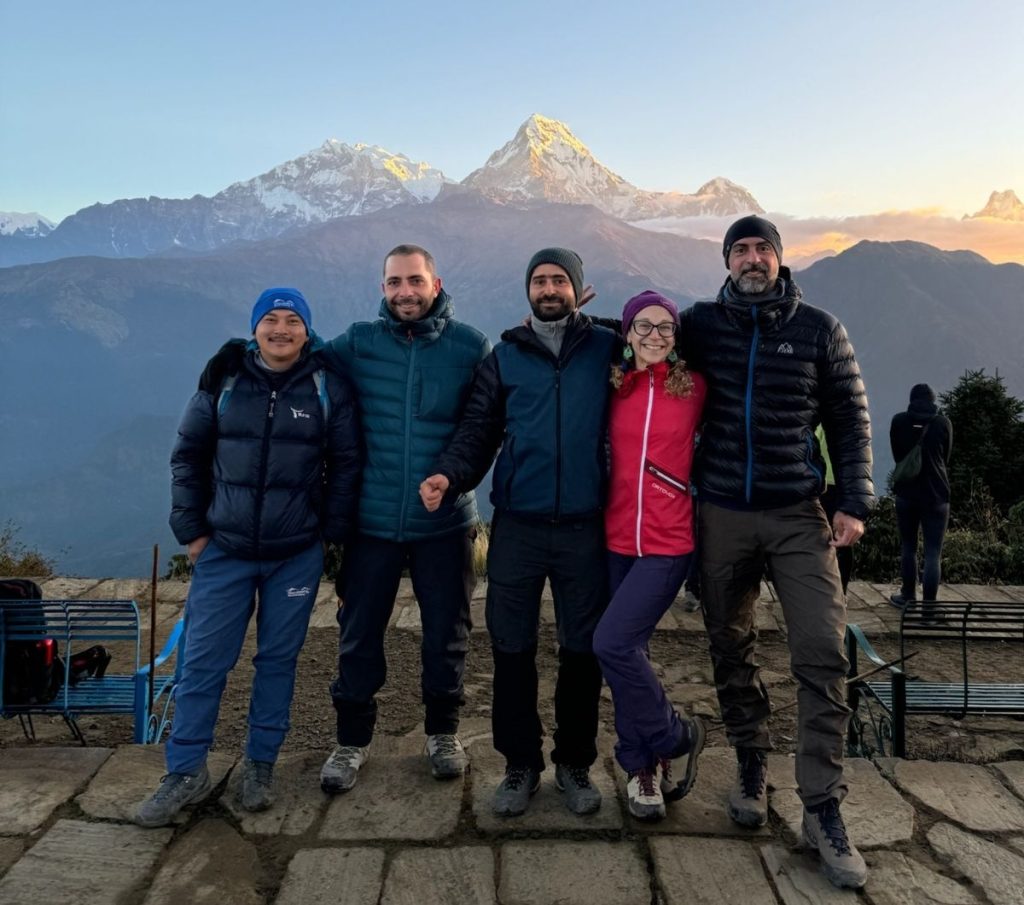
Choose Ghandruk trek for a period of almost a week as it’s a good balance of days for most individuals, with two days of no challenge before the actual climb starts.
If you are fit and you’ve been on a number of trekking trips, then you can try Jinhu starting point as it takes the least time. However, whichever route you choose upwards, it’s likely you will descend using Jinhu Danda.
The Upper Trail From Chhomrong to Annapurna Base Camp
This is the part every ABC trekker shares. Most people split it over two or three days, depending on where their itinerary sleeps.
Chhomrong to Bamboo
From Chhomrong (2,170m), take the steep staircase of stone steps to reach the river Chhomrong Khola, cross the bridge and make your way uphill to Sinuwa (2,340m). The trail then enters the dense forest of oak, rhododendron, and bamboo, and continues to Bamboo (2,310m). Allow 4 to 5 hours.
A little trick from our guides. Sinuwa is the last point where you have strong Wi-Fi connectivity, so send your messages home.
Bamboo to Deurali
Here, the gorge gets narrower. One passes through Dovan and Himalaya (2,920m), where one sees waterfalls cascading from the cliffs, to finally arrive at Deurali (3,230m). It takes 5 to 6 hours from Bamboo.
Some teams might stay behind at Himalaya, while others go beyond to Deurali. Good guides make the decision depending on the performance of their clients on the day of hiking.
The Avalanche Stretch Above Himalaya
The trekking route from Himalaya to Deurali and then to Machhapuchhre Base Camp lies through steep slopes. Avalanches could cross the path after heavy snowfall during winter and early spring months. One such avalanche took place near Deurali in January 2020.
In a normal autumn, right through November on the ABC trail, this stretch is rarely a worry. However, in weeks when it snows, begin early, traverse during the cold morning hours and listen if the lodge owners or your guide says wait. This is the only area where local knowledge outweighs the itinerary.
Deurali to Machhapuchre Base Camp and ABC
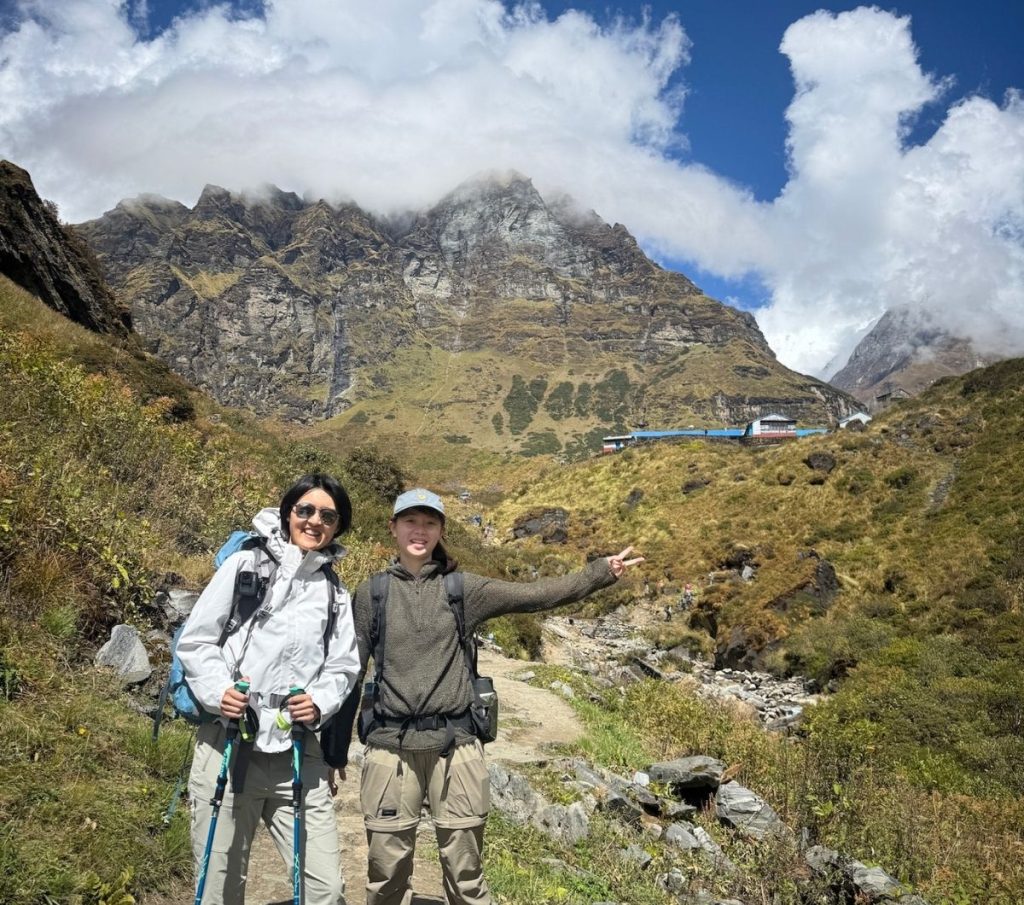
The valley broadens out after Deurali. It takes 2 to 3 hours to reach the camp at 3,700m, which is right below the base of Fishtail. From there, it will take another 2 hours to reach the Annapurna Base Camp (4,130m) through the grassy moraines near the Annapurna South Glacier.
It is a high altitude area, so you need to slow down your pace to one that feels awkward. Sit and watch how the mountain peaks around you seem to form a perfect circle. The Annapurna I, Annapurna South, Hiunchuli, Gangapurna, and Machhapuchhre mountains are all around you.
The Way Back Down
Descending is faster but tougher on your knees. Itinerary-wise, most people trek from ABC right through to Bamboo in one day, taking around 6 hours and covering almost 1,800m of elevation loss. Trekking poles do their job here for sure.
Then, you will hike uphill to Chhomrong and surprise everyone with your energy after such an elevation loss, and then descend steeply to Jhinu Danda (1,780m). Hot springs are located right under the village, along the Modi Khola river. After such a long hiking period, soaking in those hot springs is just a reward you deserve.
The final day is a short descent to Siwai or Ghandruk Phedi and then a jeep ride back to Pokhara. In case you would like to loop your trek, you can also descend via Ghandruk or Landruk.
Annapurna Base Camp Trek Route Distance and Elevation
How far you walk depends on your start. The direct route through Ghandruk or Jhinu covers about 70 to 80 km there and back. Add the Poon Hill loop and it grows to roughly 110 km.
Here is the common Ghandruk version, stretch by stretch. Times are walking hours for an average trekker, not counting long lunch stops.
| Stretch | Distance | Walking time | Height at the end |
|---|---|---|---|
| Kimche to Ghandruk | 3 to 4 km | 2 to 3 hrs | 1,940m |
| Ghandruk to Chhomrong | About 10 km | 5 hrs | 2,170m |
| Chhomrong to Bamboo | About 7 km | 4 to 5 hrs | 2,310m |
| Bamboo to Deurali | 8 to 9 km | 5 to 6 hrs | 3,230m |
| Deurali to ABC via MBC | About 8 km | 4 to 5 hrs | 4,130m |
| ABC to Bamboo | 14 to 16 km | About 6 hrs | 2,310m |
| Bamboo to Jhinu Danda | 8 to 12 km | 4 to 5 hrs | 1,780m |
| Jhinu Danda to Siwai | 4 to 6 km | 2 to 3 hrs | 1,150m |
The biggest climb comes on summit day. From Deurali you gain about 900m to reach ABC, and from Himalaya it is closer to 1,200m. That is the steepest jump in the whole Annapurna Base Camp trek elevation profile, so a slow start that morning matters more than on any other day.
On the Poon Hill version, the hardest early day is Ulleri to Ghorepani, where you gain about 800m on stone steps. It is tiring, but the altitude is still low, so it works as good training for the gorge later.
Road Access and Annapurna Base Camp Trail Conditions in 2026
The trail below has seen many changes since then. The jeep roads have been upgraded till Kimche, Siwai and Ghandruk Phedi, and during the dry season, the jeeps reach till Jhinu Danda. Hence, a 5 to 7 day trekking journey to ABC is now possible starting from Pokhara.
The 2026 monsoon season also brought some changes. According to reports from the area, the road between Syauli Bazaar and the Kimrong crossing below Ghandruk was destroyed by floods. The trekking route had to be altered and trekkers were diverted via Jhinu to Chhomrong, and the upper trail remained accessible by foot to ABC.
Road repair work proceeds quickly in this area, but changes from month to month as well. Thus, prior to each trekking start, we discuss the situation with lodge owners along the trekking route and choose the safest way out for you.
Permits, Checkpoints and Guides For ABC Trek
All ABC trails fall within the Annapurna Conservation Area, so you require an ACAP permit costing NPR 3,000, which is roughly USD 22 for foreign trekkers. Additionally, most trekkers also have a TIMS card organized by trekking agencies along with the permit.
There are a few checkpoints where your documents will be checked. For the Poon Hill trail, you should begin from the Birethanti checkpoint and go through the checkpoint at Chhomrong. Keep your permits in a waterproof bag at the top of your backpack.
From 2023 onwards, Nepal made it mandatory for all foreign trekkers to have a guided tour within its protected areas. This requirement is justified on this trek as well. Your guide will know which lodge can provide accommodation during the peak season, when the avalanche section is safe, and which approach is accessible post-monsoon season.
Best Time to Walk the Annapurna Base Camp Trek Route
Spring, from March to May, is great for the lower route. The rhododendron forests around Ghorepani and Sinuwa turn red and pink, especially in April.
Autumn, from late September to November, gives the clearest skies and the steadiest trail. It is also the busiest time, October ABC trek in particular, so lodges above Bamboo fill up early in the day.
Winter is possible but cold, and snow above Deurali can close the trail for a day or two. The monsoon, from June to August, brings cloud, leeches and landslides on the lower roads, so views and footing both suffer.
Our Two Annapurna Base Camp Trek Routes
We run the route two ways, built for two kinds of trekkers.
| Package | Days | Approach | Start and finish | Price per person |
|---|---|---|---|---|
| Annapurna Base Camp Trek | 11 | Poon Hill via Tikhedhunga, Ghorepani and Tadapani | Kathmandu | USD 730 to 800 |
| Short Annapurna Base Camp Trek | 7 | Ghandruk via Kimche | Pokhara | USD 580 to 685 |
Both trips come down through Bamboo and the Jhinu Danda hot springs, and both include a licensed guide, one porter for every two trekkers, teahouse stays and meals on the trail.
The 7-day ABC trek version is fast. Barnaby Fitzhugh from Denver walked it and said summit day alone gains more than 1,200m. He loved reaching the amphitheater of peaks, but would not suggest it for a first trek.
On the same route, Wilhelmina Aldercroft from Bristol noticed her guide chose to sleep at Sinuwa instead of Chhomrong. That small call made the next morning shorter, and it is the kind of pacing decision our guides make every day.
What Trekkers Ask About Annapurna Base Camp Trek Route
What is the best route to Annapurna Base Camp?
Is there only one trail above Chhomrong?
Can I drive part of the way to Annapurna Base Camp?
How many days do I need for the ABC trek route?
Is the Annapurna Base Camp trek route safe?