


Table of Contents
Overview of Annapurna Base Camp Trek Elevation
For many trekkers, the idea of the Annapurna Base Camp trek sparks excitement, but the high elevation often brings uncertainty. Questions like “How high will I go?”, “Will altitude affect me?”, and “Is Annapurna Base Camp too demanding?” naturally arise when planning the journey.
In this dilemma, the Annapurna Base Camp trek elevation profile can help you prepare more effectively, both physically and mentally. In this blog post, we will explain how high you’ll go, your daily elevation gains, and why this trek remains achievable for a wide range of fitness levels, so you can trek with confidence, not guesswork.
Starting Elevation of the Annapurna Base Camp Trek
The Annapurna Base Camp Trek officially starts with the drive from Kathmandu to Pokhara, but the actual trekking trail begins at different points depending on the itinerary design. The usual and common starting point is Nayapul, which is located at an elevation of 1,070 m. One can reach Nayapul via a drive from Pokhara. From Nayapul, trekkers walk along the Modi Khola valley, cross hanging bridges, and slowly proceed to the well-known stairways of Ulleri.
Likewise, some newly planned routes may start the journey from Tikhedhunga (1,570 m) instead. This route shortens the first day’s walking by avoiding some lower-valley road sections, while still maintaining a slow, steady climb in altitude. Further, in some short ABC treks, the trek starts at Jhinu Danda (1,780 m) in the Annapurna region.
No matter where the trek starts, one of the major benefits of the Annapurna Base Camp trek is that all the starting points sit at fairly low altitudes. At these elevations, oxygen saturation remains high, and hence one can trek comfortably without encountering altitude sickness.
Daily Elevation Gain on the Annapurna Base Camp Trek
The daily elevation gain on the trek to Annapurna Base Camp is about 400 to 800 m. This gradual rise helps your body adjust naturally to the altitude. Also, the trail does not climb straight up all day. Instead, it ascends and descends, which gives your body short breaks while still moving higher.
Below is a typical elevation progress based on our 11-day Annapurna Base Camp Trek itinerary:
| Day | Trekking Section | Starting Altitude | Ending Altitude | Altitude Gain/Loss |
| 1 | Drive from Kathmandu to Pokhara | 1,324 m | 820 m | – 504 m |
| 2 | Drive to Nayapul – Birenthanti – Tikhedhunga; Trek to Ulleri | 820 m | 1,540 m | + 720 m |
| 3 | Trek from Ulleri to Ghorepani | 1,540 m | 2,860 m | + 1,320 m |
| 4 | Hike to Poon Hill (3,210m), then trek to Tadapani / Chuile | 2,860 m | 2,630 m / 2,309 m | – 230 m / – 551 m |
| 5 | Trek from Tadapani / Chuile to Chhomrong / Sinuwa | 2,630 m / 2,309 m | 2,165 m / 2,340 m | – 465 m / + 31 m |
| 6 | Trek from Chhomrong / Sinuwa to Himalaya / Deurali | 2,165 m / 2,340 m | 2,890 m / 3,174 m | + 725 m / + 834 m |
| 7 | Trek from Himalaya / Deurali to ABC via MBC (3,700 m) | 2,890 m / 3,174 m | 4,130 m | + 1,240 m / + 956 m |
| 8 | Trek from ABC to Bamboo | 4,130 m | 2,350 m | – 1,780 m |
| 9 | Trek from Bamboo to Jhinu Danda | 2,350 m | 1,780 m | – 570 m |
| 10 | Trek from Jhinu Danda to Siwa / Ghandruk Phedi & drive to Pokhara | 1,780 m | 1,150 m (drive to 820 m) | – 630 m (trek) |
| 11 | Drive from Pokhara to Kathmandu | 820 m | 1,324 m | + 504 m |
From the above Annapurna Base Camp Trek elevation table, it is clear that the biggest altitude gains on the ABC trek happen on days like Ulleri to Ghorepani (gain = 1,320 m) and the final climb from Deurali to Annapurna Base Camp (gain = 1,240 m). These are the days when you feel the altitude increase the most. However, numbers alone do not tell the full story. The trail condition also makes a bigger difference than the actual elevation gain. For example, the long stone staircases around Chhomrong can feel extremely tiring, even if the altitude gain looks moderate on paper. Above Deurali, the cold and thin air makes breathing harder, so even short climbs feel slow and demanding.
Highest Point on the Annapurna Base Camp Trek
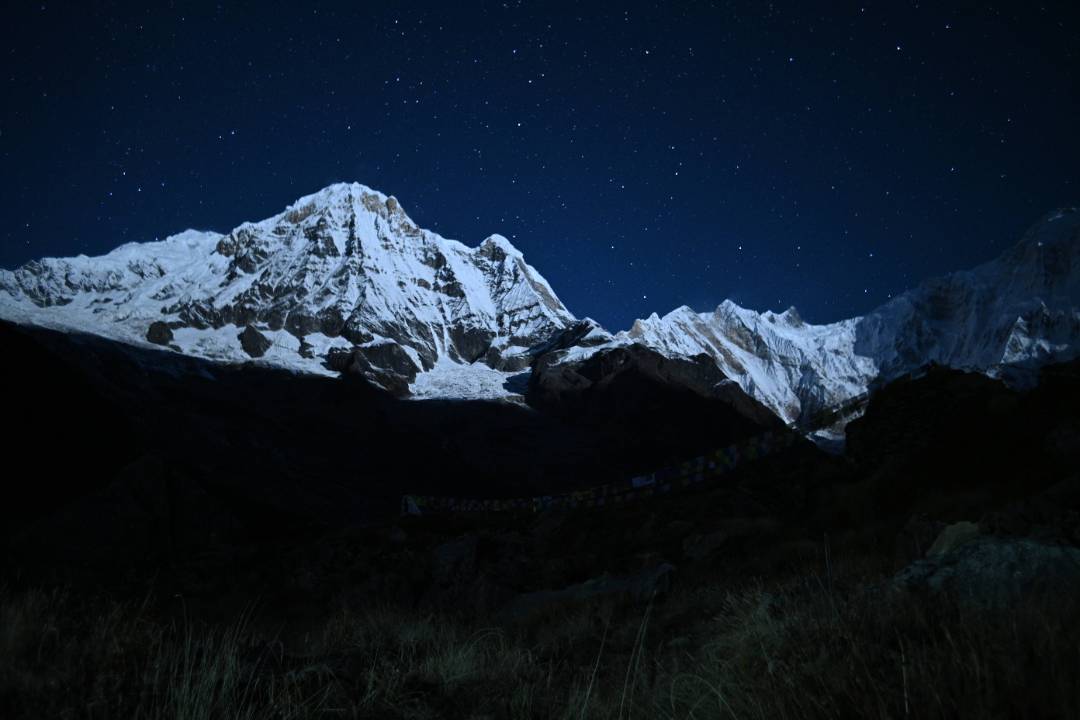
The highest point of the Annapurna Base Camp trek is Annapurna Base Camp (4,130 m) itself, where you stand in the Annapurna Sanctuary, surrounded by high mountains like Annapurna I (8,091 m), Annapurna South, Hiunchuli, and Machhapuchhre. It feels like being in the middle of a huge mountain bowl.
This bowl-shaped “Sanctuary” traps cold, thin air and blocks strong winds, which makes the area calmer than high mountain passes. Even though the air is cold and thin, many trekkers sleep better here than expected. Furthermore, many people do not realize that how ABC feels depends on how slowly you climb. Trekkers who spend extra time at places like Deurali and Machhapuchhre Base Camp (MBC) often feel comfortable at ABC.
Those who rush up from lower areas to high altitude usually feel the altitude more strongly. You can think of the walk from MBC to ABC like stepping from a high balcony onto the roof of the Sanctuary. The elevation gain is small, but the feeling of being surrounded by ice and peaks is very powerful.
How Elevation Affects the Body During the Trek
The elevation gain does affects the body during the trek. On the lower parts of the trek (below 2,500 m), most trekkers struggle with heat, sweating, and tired legs from climbing endless stone steps. But as you ascend on the Annapurna Base Camp trek, your body undergoes a significant transformation to adapt to the thinning air.
These changes often happen quietly. You may notice that your breathing rate increases, your heart beats faster even when resting, and you feel thirstier than usual. These are not signs of sickness. But these are normal ways your body tries to increase oxygen delivery by producing more red blood cells.
Beyond the usual symptoms, the Annapurna Base Camp Trek elevation also affects your internal recovery systems. At higher altitudes, especially above 3,000 m, your body recovers more slowly. Many trekkers sleep lightly or wake up often at night. This is called periodic breathing or lighter sleep cycles, and it happens as your brain adjusts its oxygen sensors.
Digestion also slows down as the body prioritizes oxygen for your heart and lungs. This is why heavy meals can feel uncomfortable at places like Deurali or MBC. Light, carb-rich foods such as Dal Bhat are easier to digest and give steady energy. Muscle recovery is slower, too, so drinking enough water and resting well becomes more important than strength alone.
Nonetheless, the ABC trek is still easier than many other high-altitude treks like the Everest Base Camp Trek (EBC). On the trek to ABC, you only sleep one night at the highest point (4,130 m). But in the EBC, trekkers stay above 4,000-5,000 m for many days.
Furthermore, if you feel uncomfortable at ABC, you can descend to Bamboo (2,350 m) in just a few hours, where the air feels much thicker, and breathing becomes easier. This quick drop in altitude helps your body recover fast. Because of this, Annapurna Base Camp is often considered the best first high-altitude trek in the Himalayas.
Common Elevation Mistakes
One of the biggest mistakes trekkers make on the trek to Annapurna Base Camp is rushing from low villages to high camps such as Deurali, MBC, or even ABC in a single day. It surely increases the risk of acute mountain sickness. Another common mistake is skipping the acclimatization stops at natural checkpoints like Chhomromg or MBC just because the trail feels easy. Later that evening, many trekkers then suffer from headaches, nausea, or sleeplessness.
Other than this, other common elevation mistakes on the ABC Trek are:
- Ignoring early warning signs (headache, loss of appetite, or unusual fatigue) and treating them as normal tiredness.
- Not drinking enough water (2 to 2.5 litres daily).
- Trying to finish ABC in a week without buffer days.
Acclimatization on the Annapurna Base Camp Trek
The Annapurna Base Camp standard trek itinerary itself builds an acclimatization curve. Over several days, you gradually move from about 1,000 m to 4,000 m and stay overnight at villages such as Ulleri, Ghorepani, Tadapani, Chhomrong, and Deurali. These stops allow your body to adjust to thinner air before sleeping yet again at a higher altitude.
In the ABC trek, good acclimatization boils down to smart trekking habits. Walking at a comfortable, conversational pace, taking short and frequent breaks, and reaching your lodge early to rest, eat, and hydrate all go a long way to acclimatizing your body. One handy tip is to consider afternoons above 3,000 m as little acclimatization sessions. A short, leisurely walk around the village after you have dropped your backpack exposes your body a little more to the altitude without you tiring too much.
The trekking trail also encourages natural acclimatization. There are short downhill sections even on ascent days, so your body gets a chance to adjust a little more efficiently than if it were a continuous climb. Frequent village stops serve as natural pacing points, thereby maintaining oxygen balance without long periods of inactivity.
Not to mention, your walking rhythm also makes a difference. A slow, steady pace with good breathing is much more effective than rushing and taking long rests. To cope with altitude sickness, it’s essential that you drink plenty of water to stay hydrated, eat warm meals, and go to bed early, especially at elevations above 2,500 m.
Perfect Time to Trek Considering Elevation
From an elevation point of view, the most suitable time for the Annapurna Base Camp trek is when the weather and temperatures stay steady and predictable. Stable weather matters at high altitude because your body is already working hard to adjust to thin air. Cold winds, heavy snow, or sudden storms can make acclimatization harder and increase fatigue. Considering this, the Spring and Autumn seasons are the best times for a trek to Annapurna Base Camp.
Spring (March to May) offers very stable conditions for altitude gain. Temperatures are moderate, and the air is slightly more humid than in winter, which most trekkers find easier on their lungs. When you go up through the rhododendron forests at around 2,500 m, the mild weather allows you to have more energy for the upper parts near Deurali and Base Camp.
Autumn (September to November) is known for its clear skies and stable air pressure following the monsoon. Even though the air at 4,130 m remains crisp and cold, the weather is typically dry and quite predictable. As a result, trekking through the high valley above Deurali becomes not only safer but also more comfortable, along with the best views of the Annapurna massif of the season.
Additionally, there is a lesser-known benefit to trekking during the early or late shoulder weeks of these seasons. The trails are quieter due to fewer trekkers, and the teahouses are less crowded. When your body is adjusting to 3,000-4,000m, better sleep and a calm lodge environment can significantly enhance your recovery and acclimatization, more than you would experience during peak-season crowds.
Conclusion
This way, when you look at the Annapurna Base Camp elevation profile, it changes the scenic walk into a well-planned mountain journey. Every village along the trek route serves as a physiological checkpoint and helps your body adjust to the elevation gain. When trekkers understand the starting elevation, daily altitude gain, highest points, and common altitude mistakes, they can choose better itineraries and walk at a steady, comfortable pace. This reduces tiredness and makes trekking days much more enjoyable.
If there is one key lesson, it is this: the goal of the Annapurna Base Camp trek is not only to reach Base Camp. True success is returning safely to lower villages feeling strong, confident, and proud, knowing you managed the elevation wisely, not rushed it.